
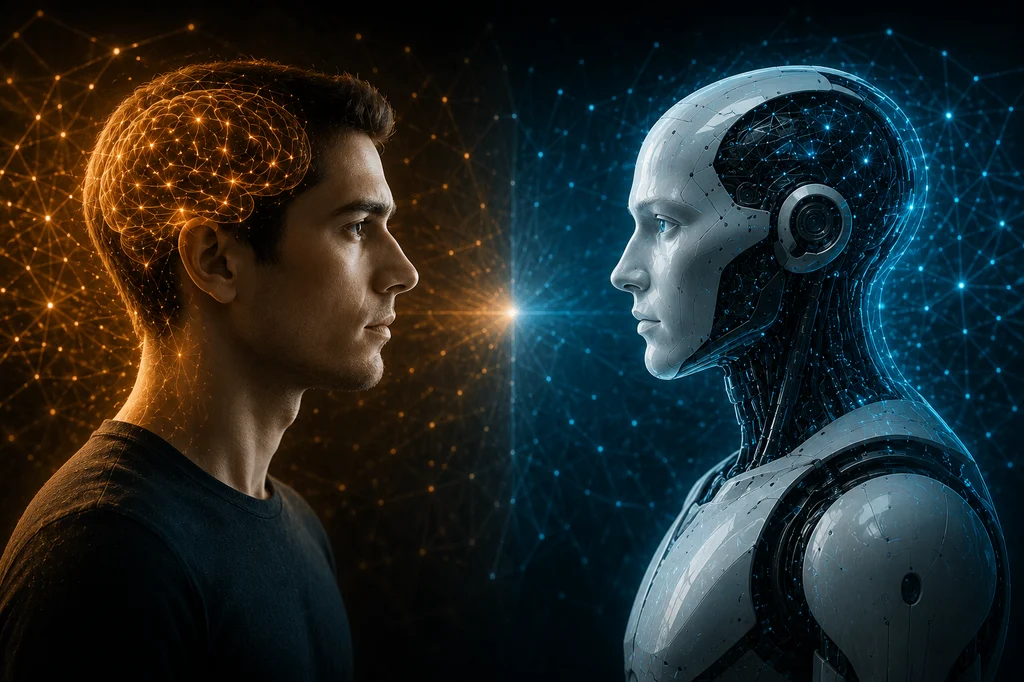
The AI-vs-human debate is often framed like a boxing match: one side must win, the other must lose. Your original draft takes a more useful path. Instead of asking who is "smarter" in absolute terms, it asks how two very different cognitive systems process information, make mistakes, and create value in different conditions.
This longread keeps that spirit and turns it into a practical pillar article: an operational map for readers who need to make decisions with AI, not just opinions about AI.
What we mean by intelligence
The first obstacle in any comparison is definitional. Science still has no single, universally accepted definition of intelligence. That ambiguity makes public discourse unstable: people can "win" arguments simply by switching criteria midstream.
A practical workaround, reflected in your source text, is to treat intelligence as a functional bundle rather than a metaphysical status. In that bundle, intelligence includes the ability to:
- learn from new material;
- infer from incomplete information;
- decide under uncertainty;
- transfer knowledge across domains;
- adapt to changing environments.
This framing does not solve the consciousness question, but it does make comparison usable. Humans and AI both express parts of this bundle, yet they arrive there through different mechanics. That difference is where the strategic value lies.
Architecture: embodied biology vs statistical computation
Human cognition is inseparable from biology. Hormones, fatigue, stress responses, motivation, and emotion continuously shape judgment. There is no fully detached "pure reason" module in everyday human decision-making.
Modern large language models operate differently. They are mathematical systems built around weights, tokenization, attention, and probabilistic next-token prediction. They do not feel pain, fear, urgency, shame, or care in a first-person sense. They generate outputs; they do not experience them.
This architecture gap explains both strengths and constraints:
- AI is robust against many human state fluctuations (tiredness, mood swings);
- humans remain better at value-laden interpretation in messy social reality;
- models scale computation, humans scale contextual meaning and accountability.
Anthropomorphism blurs this line. Treating models as intentional agents creates false trust. Treating humans as "slow models" erases embodied intelligence.
The learning paradox: few-shot humans, data-hungry models
One of the sharpest contrasts in your draft is learning cost. Humans learn over years through repetition, trial and error, sensory grounding, social feedback, and sleep-based consolidation. We can often generalize from a small number of examples because we carry deep priors built by evolution and culture.
AI systems, by contrast, are usually pre-trained on vast corpora. They require massive token exposure to produce broad competence, and that pretraining phase is computationally expensive. Afterward, inference can be fast, but knowledge remains bounded by training cutoff, context window, and tool access.
It is still important to avoid simplistic binaries. Methods are evolving quickly. But the asymmetry is stable enough to guide workflow design:
- humans often excel at high-level reframing from sparse context;
- models excel at pattern extraction and synthesis at scale.
In practice, this supports a hybrid architecture: AI for breadth and speed; humans for objective-setting, constraints, and final judgment.
Memory and context: same word, different phenomenon
People often say "the model remembers" as if that were equivalent to human memory. It is not.
Human memory is layered and reconstructive: working memory, long-term memory, procedural memory, autobiographical memory. We do not replay exact recordings; we reconstruct meaning, which enables flexibility but also distortion and false recall.
Model "memory" is usually a blend of:
- learned parameters (compressed statistical traces of training data);
- active conversation context;
- optional external retrieval (RAG, tools, databases).
During dialogue, an LLM does not possess autobiographical continuity in the human sense. It processes available context. If context is truncated or noisy, performance shifts. External retrieval can simulate persistence, but this is still not lived memory.
This distinction matters for governance and product expectations. Humans are expected to hold personal commitments across time. Models are expected to process provided context transparently and fail gracefully when context is insufficient.
Hallucinations and cognitive bias: different systems, similar risk pattern
Your source text makes a strong move here: hallucination is not exclusively a machine story. Humans also construct coherent but incorrect narratives. False memories, confirmation bias, motivated reasoning, and eyewitness unreliability are all well-documented.
The useful distinction is not "human true vs machine false." It is error taxonomy:
- human errors are often shaped by fatigue, identity, emotion, social pressure;
- model errors are often shaped by prompt ambiguity, missing grounding, noisy priors, and plausibility bias.
Quality control must therefore be system-specific. Humans need structured reflection and external challenge. Models need explicit constraints, source grounding, adversarial prompts, and consistency checks.
The highest-risk shared failure mode is confident output with weak support. Humans do this in rhetoric; models do this in fluent generation.
Logic, intuition, and creativity: where similarity is uncomfortable
It is tempting to split the world into AI-logic and human-intuition. Reality is messier.
Models can produce elegant logical chains and still end in nonsense if a key premise is wrong. Humans may sense absurdity earlier but then rationalize conclusions that align with identity or prior beliefs. Both systems can be "internally coherent" and externally wrong.
Creativity has a similar duality. AI recombines learned patterns at high speed and scale. Humans also recombine, but through embodied history, motivation, and social meaning. Completely novel creation is rare in both cases; what differs is intention, situated judgment, and ownership of consequences.
Intuition can be interpreted as compressed statistics from prior experience. In that limited sense, there is a structural analogy with model inference. But human intuition remains entangled with affect and lived stakes.
Operationally, this supports complementarity: models are excellent at option generation and combinatorial exploration; humans are better at selecting among options based on values and downstream impact.
Emotion, consciousness, and the accountability boundary
Emotion is not decorative. It is part of human valuation and prioritization. Fear, empathy, attachment, and moral discomfort influence what choices are acceptable. Models can mimic emotional language without subjective experience.
Consciousness remains unresolved scientifically, so definitive claims about machine self-awareness are premature. A pragmatic engineering stance is still appropriate: treat AI as a high-capability tool, not a moral subject.
That leads to the accountability boundary. In high-stakes decisions, legal and ethical responsibility remains human. Doctors, pilots, engineers, managers, and editors cannot outsource liability to model outputs.
This is why "human in the loop" is not merely a temporary patch. It is a design principle for systems where error costs are asymmetric and socially distributed.
Labor transformation: replacement narrative vs role redesign
The "AI will replace everyone" narrative is simple, dramatic, and often analytically weak. What we see more often is role decomposition:
- routine and first-pass analysis shifts toward AI;
- human work shifts toward framing, verification, exception handling, and stakeholder accountability;
- value increases for people who can design robust AI-assisted workflows, not just produce fast prompts.
This pattern is visible across software, education, research, healthcare, operations, and legal workflows. As automation grows, so does the need for explicit validation design and traceability.
In other words, AI literacy is no longer just interface literacy. It is process literacy: how to separate claim from evidence, how to test assumptions, how to document uncertainty, and how to communicate residual risk.
5-10 years and beyond: agents, autonomy, and governance lag
Your original draft forecasts a move from chat interfaces to persistent personal agents. That trajectory is plausible: systems are increasingly capable of multi-step execution, memory-like context handling, and tool-mediated action.
At the same time, technical acceleration and institutional adaptation move at different speeds. Regulatory frameworks, liability doctrine, procurement norms, and public trust usually lag capability curves.
So long-range predictions should be treated as scenario ranges, not certainties. Breakthroughs are possible, but outcomes will be shaped as much by governance, education, and incentives as by raw model performance.
The practical conclusion is disciplined optimism: build for upside while engineering for misuse, fragility, and accountability.
Practical comparison matrix
| Dimension | Human | AI |
|---|---|---|
| Compute speed | Low to medium | Very high |
| Emotion | Native and decision-relevant | Simulated expression |
| Intuition | Experience-driven heuristics | Statistical approximation |
| Memory | Limited, reconstructive | Large via parameters + retrieval |
| Fatigue | Present | Not human-like |
| Creativity | Biographically grounded | Combinatorial and scalable |
| Responsibility | Human-borne | No subject-level accountability |
The point is not ranking. The point is allocation: who should do what, under what risk tolerance, with what oversight.
FAQ
Are AI and humans "the same" because both can be wrong?
No. They share uncertainty-driven failure patterns but differ in mechanism, stakes, and correction pathways.
Is human intuition basically model inference?
Only as a partial metaphor. Human intuition is tied to embodiment, emotion, and lived social context.
Why does AI often avoid saying "I don't know"?
Because generation objectives optimize plausible continuation, not subjective humility.
Will experts disappear in AI-native fields?
More likely their roles will reconfigure toward supervision, judgment, and accountability.
What should teams implement first?
Role separation, evidence-grounded prompting, risk-scaled verification, and decision logs for contested outputs.
Conclusion: the key question is not superiority, but system design
The strongest idea in your source text is not that AI is superior or inferior. It is that we are comparing different cognitive architectures with overlapping but non-identical capabilities.
A workable future is not machine triumph over human judgment, nor human refusal of machine assistance. It is coordinated intelligence: AI for speed, breadth, and draft-space exploration; humans for goals, ethics, responsibility, and consequence-aware decisions.
That framing reduces ideological noise and improves real-world decisions where mistakes carry actual cost.