
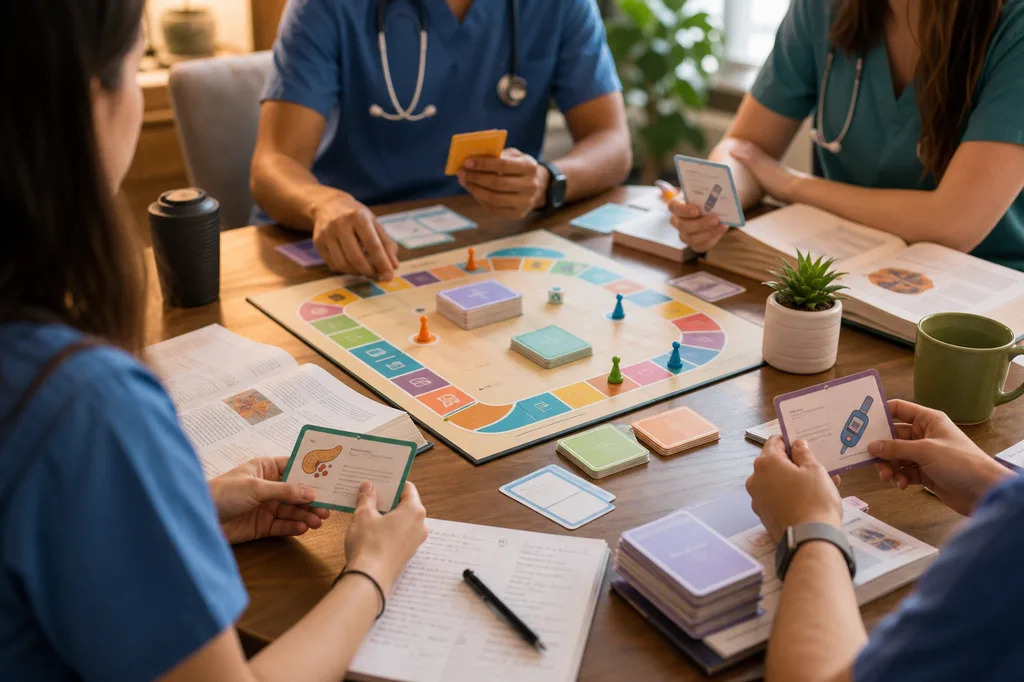
Illustration: board-game-based diabetes review for medical students — conceptual image, not from the cited study.
In one sentence
Medical students who played the Candy Gland diabetes review game showed a small increase in knowledge scores and reported feeling more confident about diabetes management afterward.
What the researchers did
The study described and evaluated Candy Gland, a board game created to help medical students review core diabetes concepts in a more active and social way. The game was designed around common learning mechanics: players moved through a board, answered flashcard-style prompts, and discussed diagnosis and management topics tied to diabetes care.
The educational context matters here. Diabetes is common, clinically important, and often taught across many separate sessions rather than in one concentrated block. That can make it harder for students to organize what they know. The authors wanted a format that encouraged retrieval, repetition, and peer discussion rather than passive review alone.
The intervention was used with 102 medical students. Students completed a pre-activity knowledge test, played the game in small groups, and then completed a post-activity test and survey. The main quantitative outcomes were change in test scores and self-reported confidence in managing diabetes-related topics.
The paper reports that the average knowledge score rose from 7.3 to 8.0 out of 10 after the activity. Survey responses also suggested that confidence improved. Because the game used question cards and repeated retrieval in a group setting, it functioned somewhat like a collaborative flashcard review session wrapped in a more playful format.
What they found
The main headline result was modest but positive: students scored better after the game than before it. Moving from 7.3 to 8.0 out of 10 is not a huge jump, but it points in a favorable direction for a short teaching intervention.
The confidence findings may be just as interesting as the test scores. Students reported feeling more comfortable with diabetes concepts and management after participating. In early clinical training, confidence is not the same thing as competence, but confidence can matter if it reflects better organization of knowledge and greater willingness to engage with patients and cases.
The authors also present Candy Gland as a practical teaching tool. Because it combines question prompts with group interaction, it may encourage the kind of active recall and immediate explanation that often makes review sessions more memorable than solitary rereading.
At the same time, the effect size should be interpreted cautiously. This was not a dramatic transformation in scores, and the study was more a proof of feasibility and educational value than a definitive demonstration of superior learning.
What this means for learners and educators
For teachers, the study is a reminder that format shapes participation. Even when the content is familiar, putting it into a structured game can increase attention, discussion, and repeated retrieval opportunities.
For learners, Candy Gland looks less important as a literal board game and more as an example of a principle: review works better when you are asked to pull information from memory, explain it, and compare your reasoning with peers. A deck of cards, a whiteboard, or a digital quiz game could potentially serve a similar role.
The study also fits a broader pattern in health professions education. Small-group active learning does not need to be elaborate to be useful. If an activity gets students retrieving key facts, applying them to cases, and talking through management decisions, it may support both knowledge and confidence.
For curriculum designers, the result suggests that gamified review can be a reasonable supplement for dense, high-yield topics like diabetes, especially when time is limited and engagement is a concern.
Limitations and what we don't know yet
This was a relatively small educational evaluation without a separate control group doing a different review activity. That means we cannot say the board game was better than standard flashcards, a quiz session, or a brief faculty-led review.
The gain in scores was encouraging but modest, and the study does not answer whether students retained the material weeks or months later. Immediate post-test improvements can fade quickly if there is no follow-up practice.
Confidence measures should also be handled carefully. Feeling more confident after a fun review session may be helpful, but it does not automatically mean students will perform better in clinic or on later exams.
So the best reading of the paper is practical rather than grand. Candy Gland appears to be a workable, engaging review tool for diabetes education, but stronger comparative studies would be needed to show whether game-based retrieval offers a durable advantage over simpler active-learning formats.