
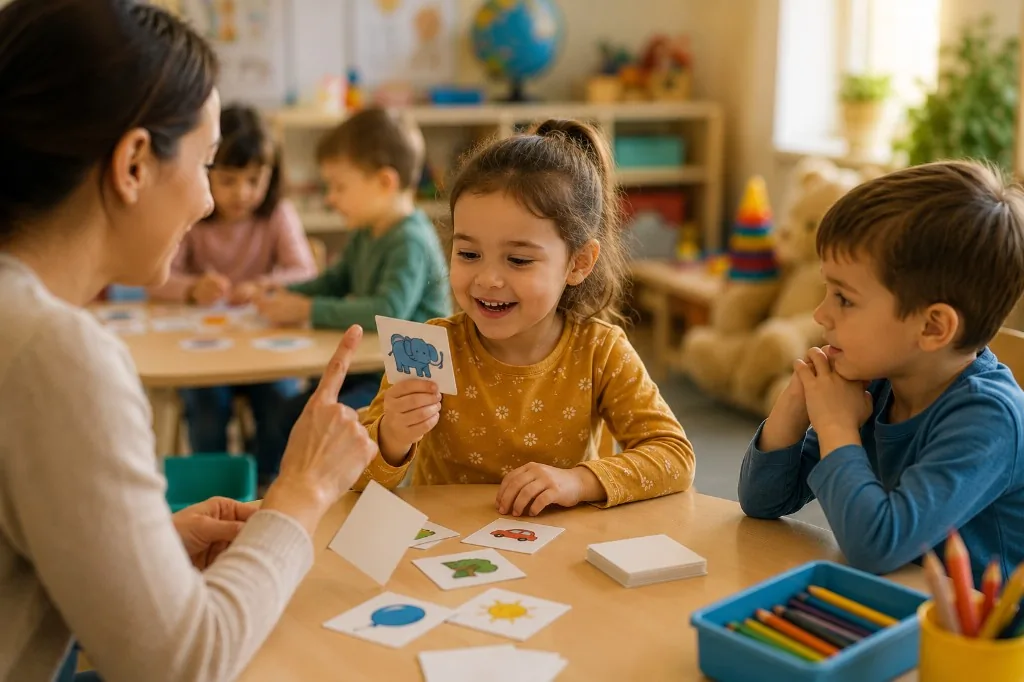
Illustration: guided recall with flashcards in early childhood — conceptual image, not from the cited study.
Short version
Retrieval practice — actively trying to remember information instead of simply reviewing it — is usually discussed in the context of older students, exams, or adult learning. But new research suggests the basic idea may work much earlier than many people assume.
In two experiments with preschool children, researchers found that five- and six-year-olds remembered information better over time when they practiced recalling it from memory. However, the effect depended on something important: children benefited mainly when the learning process allowed them to succeed often during the early practice stages.
In other words, retrieval practice worked best when the children first built confidence through repeated successful attempts rather than being pushed into difficult recall too quickly.
What the researchers studied
The study involved 202 preschool-aged children across two experiments.
Researchers taught children new material and then compared different learning approaches. Some children practiced retrieval by trying to recall information from memory, while others mainly reviewed the material again.
After a delay, the researchers tested how much the children remembered.
A major focus of the study was not simply whether retrieval practice helped, but under what conditions it helped. The team wanted to understand whether young children need a certain level of mastery before retrieval becomes useful rather than frustrating.
To explore this, they compared situations where children experienced frequent success during practice with situations where their initial understanding was weaker.
The researchers also examined whether the effects depended on the exact testing format. For example, they looked at both free recall and recognition tasks and checked whether retrieval benefits remained even when the final test differed from the original practice activity.
What they found
The results suggest that the testing effect appears surprisingly early in development.
Children who practiced retrieval generally remembered more information later than children who only restudied the material. But the size of the benefit depended heavily on how successful the children were during the initial learning process.
When children first went through several learning rounds and achieved a high rate of correct answers, retrieval practice produced a meaningful improvement in later memory performance. When early success was weaker, the advantage became much smaller.
This finding supports an idea that many teachers intuitively recognize: difficult memory challenges may help learning only after children feel reasonably confident with the material.
The researchers describe the effects as moderate but reliable, with effect sizes around d ≈ 0.32. Importantly, the benefits appeared across different kinds of memory tests and did not require the final assessment to perfectly match the original practice format.
Why this matters
Early childhood education often relies heavily on repetition, exposure, and guided instruction. Many people assume retrieval practice is too cognitively demanding for younger children.
This study challenges that assumption.
The findings suggest that preschool children are capable of benefiting from memory-based learning techniques — but only when the tasks are carefully scaffolded. Young learners may need multiple opportunities to succeed before retrieval becomes productive rather than discouraging.
That has practical implications for parents, teachers, and educational apps.
Instead of immediately asking children to “remember on their own,” it may be more effective to begin with short, highly achievable activities where success happens frequently. As confidence grows, retrieval challenges can gradually become more difficult.
The broader lesson is that retrieval practice is not simply about making learning harder. It is about creating the right balance between challenge and success.
Limitations
The study was conducted under controlled experimental conditions rather than across large numbers of everyday classrooms or kindergartens.
The public summary also provides limited detail about long-term follow-up and classroom implementation.
As with most educational research, individual differences likely matter as well. Factors such as attention, language development, motivation, or learning environment may influence how strongly individual children benefit from retrieval-based learning.
Final thoughts
The study suggests retrieval practice is not “too advanced” for preschool children by default.
What matters most is the structure surrounding it.
When young learners experience repeated early success, retrieval can strengthen memory even at five or six years old. But if the process becomes too difficult too quickly, the benefits may disappear.
The most effective early-learning systems may therefore be the ones that combine gradual difficulty, encouragement, and achievable recall challenges — helping children build both memory and confidence at the same time.
This is a plain-language summary of: “Multiple Practice Success Scaffolds Long-Term Test-Enhanced Learning in Preschoolers”.
Source: Child Development (2025).