
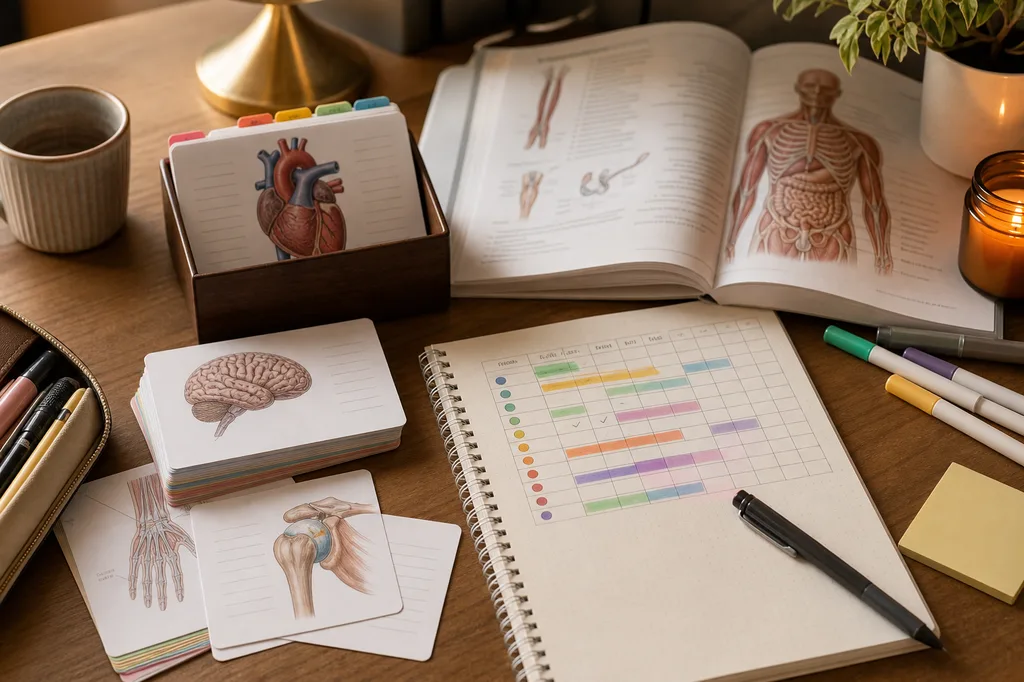
Spaced repetition for surgical training — conceptual image, not from the cited study.
In one sentence
Plastic surgery educators argue that spaced repetition flashcard systems could help trainees retain a very broad surgical knowledge base, though the article mainly outlines the idea rather than testing it in a trial.
What the researchers did
The authors reviewed how plastic surgery education has traditionally relied on textbooks, journal articles, conferences, and newer digital resources. They noted that trainees must absorb an unusually wide range of anatomy, techniques, materials, and nonsurgical topics, often under severe time pressure.
The paper explains how spaced repetition works: facts are revisited at increasing intervals based on how well a learner recalls them, with harder items appearing more often. It compares several flashcard platforms and highlights features such as customizable intervals, deck organization, statistics, and card types like image occlusion.
The team also described their own early effort at one university to build a comprehensive flashcard deck drawn from core texts and lectures, with the hope that national educational groups could eventually distribute a shared deck across residency programs.
What they found
The article does not report a randomized trial with outcome numbers. Instead, it synthesizes evidence from other medical and surgical fields suggesting that spaced repetition can support long-term retention and may improve in-service exam performance in specialties such as urology, orthopedics, and otolaryngology.
The authors propose that plastic surgery, which already uses image-heavy study materials, is especially well suited to flashcard formats that hide labels on anatomical diagrams or prompt recall of rare pathologies. They suggest that a standardized deck could support both daily study during short breaks and more exam-like mixed review sessions.
What this means for learners and educators
For any learner facing a huge fact base, the paper's practical message is straightforward: review little and often, and let difficulty drive scheduling instead of cramming everything at once. That principle applies far beyond surgery.
For educators, the piece is a call for shared infrastructure. Creating high-quality decks takes time, but distributing them may reduce duplicated effort across training sites. For trainees, the takeaway is that flashcards are not just exam hacks; they can be structured professional study tools when tied to a curriculum.
Limitations and what we don't know yet
This source is a conceptual commentary with a non-derivative license, so it cannot be closely paraphrased and should not be read as proof that plastic surgery scores will rise. No plastic-surgery-specific controlled outcomes are presented here.
Deck quality, copyright boundaries when converting textbooks into cards, and learner burnout from daily review loads all remain open questions. Readers should treat the article as a thoughtful proposal and look for future empirical studies before treating shared surgical decks as established best practice.