
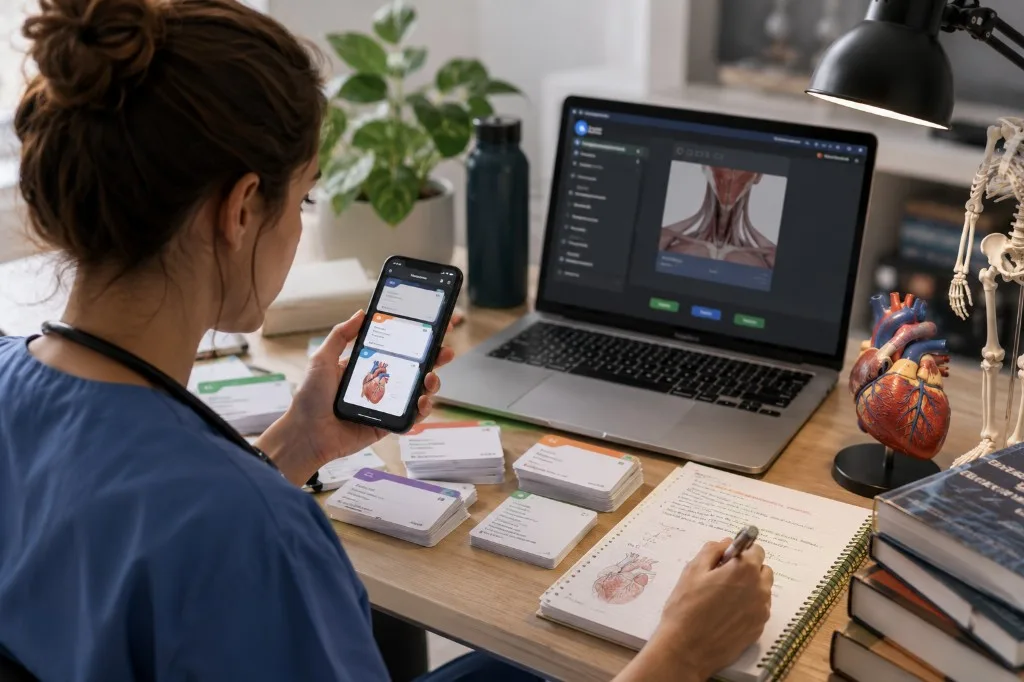
Illustration: steady Anki study alongside paper flashcards and notes — conceptual image, not from the cited study.
Short version
Anki has become almost a default study tool among medical students. But simply installing the app does not automatically lead to better grades.
A study of first-year graduate-entry medicine students found that, overall, Anki users did not achieve statistically significant exam advantages compared with students using other study methods.
However, the picture changed once researchers looked beyond simple “use vs. non-use” comparisons.
Students who used Anki consistently and extensively performed significantly better than students who used it irregularly or only occasionally.
The researchers also found a meaningful relationship between Anki usage and performance on physiology exams.
The broader lesson is familiar from learning science:
spaced repetition works more like a long-term habit than a quick productivity trick.
What the researchers studied
The study took place in a graduate-entry medicine (GEM) program, where students already held previous university degrees before entering medical school.
A total of 53 students participated, and complete data were collected from 43 of them.
During one teaching module, researchers compared:
- baseline knowledge before the course;
- exam performance after the module;
- and the study methods students reported using.
Students were also asked about their Anki habits: how frequently they reviewed cards, how much time they spent studying, and how consistently they used the platform.
About 80% of participants reported using Anki, but usage intensity varied dramatically — from occasional review sessions to daily high-volume repetition.
Researchers first compared all Anki users against non-users. They then separated students into groups based on extensive consistent use versus irregular or minimal use.
They also analyzed performance across specific subject categories such as physiology.
What the study found
Looking at the entire module overall, there was no significant difference between Anki users and non-users.
In other words, simply being “an Anki user” did not automatically predict higher scores.
But once researchers examined consistency and intensity of use, the pattern changed.
Students who used Anki regularly and extensively achieved significantly higher scores than students who used flashcards inconsistently.
The researchers also reported a statistically significant relationship between Anki usage and performance on the physiology portion of the assessment.
Another interesting observation was that students reported positive satisfaction with their preparation and time management across multiple study approaches — not only Anki. This suggests that organization, planning, and study habits still matter alongside tool choice.
Why this matters
The study highlights an important distinction between:
“having a study app”
and
“building a stable retrieval routine.”
Spaced repetition systems only work when students actually return to cards consistently, keep review loads manageable, and maintain decks that match current coursework.
This is especially relevant in medicine, where the amount of information is enormous and forgetting happens quickly.
The findings reinforce something many long-term Anki users already suspect:
Irregular use often feels exhausting and ineffective, while small but stable daily repetition tends to produce much stronger results over time.
What this could mean in practice
For students and self-learners, the practical message is fairly simple:
the effectiveness of Anki depends more on consistency than early enthusiasm.
The study indirectly supports several useful habits:
- small daily review limits are often better than occasional marathon sessions;
- decks should stay aligned with current class material;
- missed days are usually better handled by simplifying workload instead of trying to “catch up everything at once”;
- shared decks and starter templates may reduce setup friction for beginners.
For educators and medical programs, the findings also suggest that recommending Anki alone may not be enough. Students may benefit from onboarding support that teaches sustainable usage patterns rather than overwhelming study schedules.
Limitations
The study was relatively small: 53 participants, with 43 complete datasets.
It was also observational rather than experimental. Students chose their own study methods, so differences in motivation, discipline, or prior ability could influence the results.
Anki usage was self-reported, which may not perfectly reflect real study behavior.
The publicly available summary also did not examine very long-term retention over many months, and the clearest performance relationship appeared specifically in physiology rather than across every subject equally.
Final thoughts
Anki is a tool for distributed retrieval practice — not a magic academic upgrade button.
This study reinforces a practical idea:
consistency matters more than simply using the app.
For people building spaced-repetition habits, the message is straightforward: protect a manageable daily routine, keep review systems simple enough to sustain, and treat missed sessions as signals to simplify rather than abandon the method entirely.
This is a plain-language summary of: “An Assessment of Anki Flashcards Use in Comparison to Alternative Study Methodologies in First Year Graduate Entry Medical Students”.
Source: Medical Science Educator (2025).