
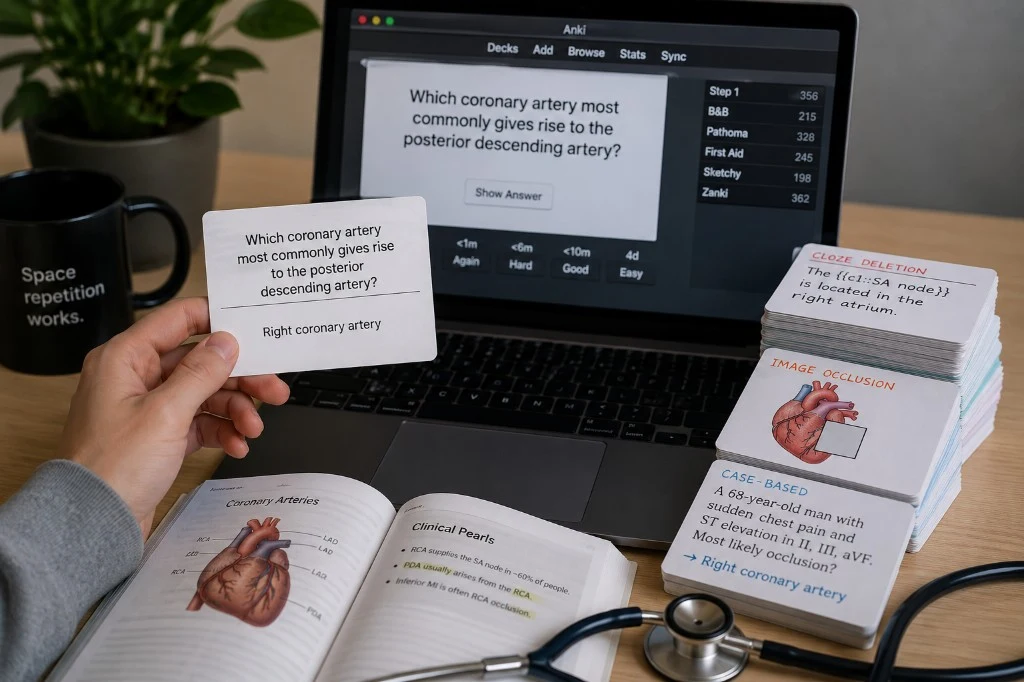
Illustration: medical flashcard study with Anki and different card formats — conceptual image, not from the cited study.
Short version
Anki flashcards are everywhere in medical school. But when students say a deck is “good,” they often mean completely different things.
One person may prefer image-heavy cloze deletions. Another may want short recall questions with minimal text. Some decks train memorization, while others try to build clinical reasoning.
Researchers created a new framework called DEAME to describe these differences more clearly — giving teachers, students, and researchers a shared language for talking about flashcard design.
What the researchers did
Balczewski and colleagues noticed a problem in medical education research: electronic flashcards are widely used, but people rarely describe how the cards themselves are designed.
Two studies might both say they examined “Anki use” while actually studying very different learning experiences.
To explore this, the team analyzed 1,300 flashcards taken from six popular medical Anki decks used in undergraduate medical education.
Instead of measuring exam performance, the researchers focused on card structure itself. They reviewed the cards repeatedly, grouped recurring patterns, refined categories, and eventually built a detailed taxonomy of flashcard design features.
The result became the DEAME framework — short for Design Elements of Anki for Medical Education.
The framework also connects card design to educational psychology models about different kinds of thinking and memory tasks.
What they found
The DEAME framework contains seven broad categories and 48 individual design elements.
Some categories describe the technical side of cards:
- images;
- audio;
- tags;
- references;
- metadata.
Others focus on how learning actually happens:
- how questions are phrased;
- whether answers require genuine recall or simple recognition;
- whether hints make guessing too easy;
- whether the card tests isolated facts or deeper application and reasoning.
The researchers argue that medical flashcards differ far more than most discussions acknowledge.
One deck may mainly train rapid factual recall. Another may encourage integration across body systems and clinical cases. Both are “Anki decks,” but cognitively they are doing very different things.
Why this matters
People often treat spaced repetition as mostly an algorithm problem: intervals, streaks, review counts, and settings.
This paper argues that card design may matter just as much.
A poorly designed card can create an illusion of learning:
- prompts may accidentally reveal the answer;
- cards may become too long and overloaded;
- learners may rely on visual familiarity instead of active retrieval.
A well-designed card, on the other hand, pushes the learner to genuinely reconstruct knowledge from memory.
The framework gives students a way to think more critically about the decks they use every day.
Instead of only asking:
“How many cards should I review?”
students can also ask:
“What skill is this card actually training?”
What this means for students and educators
For students, the study is a reminder that more cards do not automatically mean better learning.
Sometimes ten clean, focused recall cards are more effective than one giant wall of text.
For educators and deck creators, DEAME offers a more precise vocabulary for feedback. Instead of saying “this deck is bad,” teachers can point to specific problems:
- overly long question stems;
- recognition-based prompts;
- missing clinical context;
- excessive visual clutter;
- weak retrieval demands.
For researchers, the framework may help future studies compare flashcard systems more meaningfully instead of treating all electronic flashcards as one generic intervention.
Limitations
The analysis focused on English-language medical school decks shared in online communities. Personal decks, other languages, and non-medical subjects may look very different.
Importantly, DEAME is a descriptive framework, not proof that certain card types always produce better learning outcomes.
The study explains how cards differ — not which design is universally best.
The public summary also gives limited detail about agreement between coders, so future research may refine some categories further.
Final thoughts
Spaced repetition is not only about timing. It is also about the quality of the mental work each card creates.
This study suggests that the design of a flashcard may shape whether learning becomes genuine retrieval practice, shallow recognition, or simple pattern matching.
For heavy Anki users, that may be one of the most important questions to ask — not just how often you review, but what your cards actually force your brain to do.
This is a plain-language summary of Unboxing Electronic Flashcards: An Introduction to the Design Elements of Anki for Medical Education (DEAME) Framework, Balczewski EA, Barrison PD, Rajpurkar A, Fiestan K, Vadlamudi PS, Sparling M, Medical Science Educator (2025). Source license: CC-BY.
It is not professional educational or medical advice.