
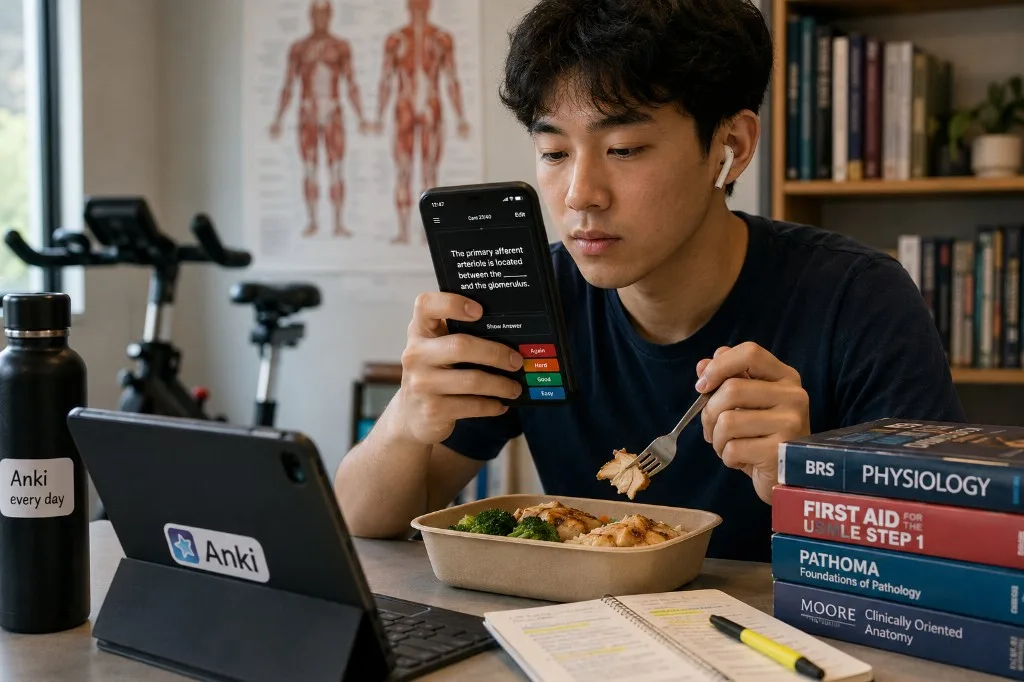
Illustration: Anki sessions woven into daily routines — meals, workouts, and study — conceptual image, not from the cited study.
In one sentence
A large class survey suggests Anki is woven into everyday life for most first-year medical students — not only as a study tool, but often during meals, workouts, and other daily routines.
What the researchers did
Medical students face enormous volumes of material and tight schedules. Anki, a free flashcard app built around spaced repetition, has become a default strategy for many learners.
Researchers at the University of Central Florida College of Medicine surveyed first-year students about how they use Anki, how confident they feel, and how the tool fits into life outside lectures. The survey was open to both Anki users and non-users and drew responses from about 74% of the class.
Most items used Likert scales. The team summarized patterns with descriptive statistics and checked whether students who relied on Anki more heavily also reported feeling more successful in their modules.
What they found
About 94% of respondents identified as Anki users. Among users, roughly 98% relied on pre-made decks rather than building their own from scratch.
Fill-in-the-blank cards were the most popular format (78%). A majority saw Anki as a core study strategy (63%) and felt it contributed strongly to module success (88%).
Many students said Anki made them more productive than other study tools (59%). A notable share reported multitasking — doing cards while eating, exercising, or during other everyday activities (57%).
Students who treated Anki as a larger share of their overall study strategy also tended to report stronger perceived success (correlation about 0.62, statistically significant).
Only a small minority were non-users, so comparisons between heavy users and abstainers were limited.
What this means for learners and educators
The study is descriptive, not an experiment: it does not prove Anki causes better grades. Still, it paints a realistic picture of how spaced-repetition tools are actually used in the wild.
For students, the takeaway may be practical: if Anki is already part of daily habits, attention to card quality, focused sessions, and occasional breaks from multitasking could matter as much as raw minutes on the app.
For faculty, the results underline that many learners are not waiting for official guidance — they are adopting external tools at scale. Short orientations on evidence-based flashcard design (simple prompts, one fact per card, honest self-ratings) may help more than ignoring the trend.
Limitations and what we don't know yet
This is a single institution, one class year, and self-reported data. Usage patterns elsewhere may differ.
The survey cannot separate correlation from causation for success ratings. It also does not measure long-term retention or objective exam outcomes in this sample.
Future work could track engagement quality (not just frequency) and test whether structured coaching on deck design improves outcomes.