
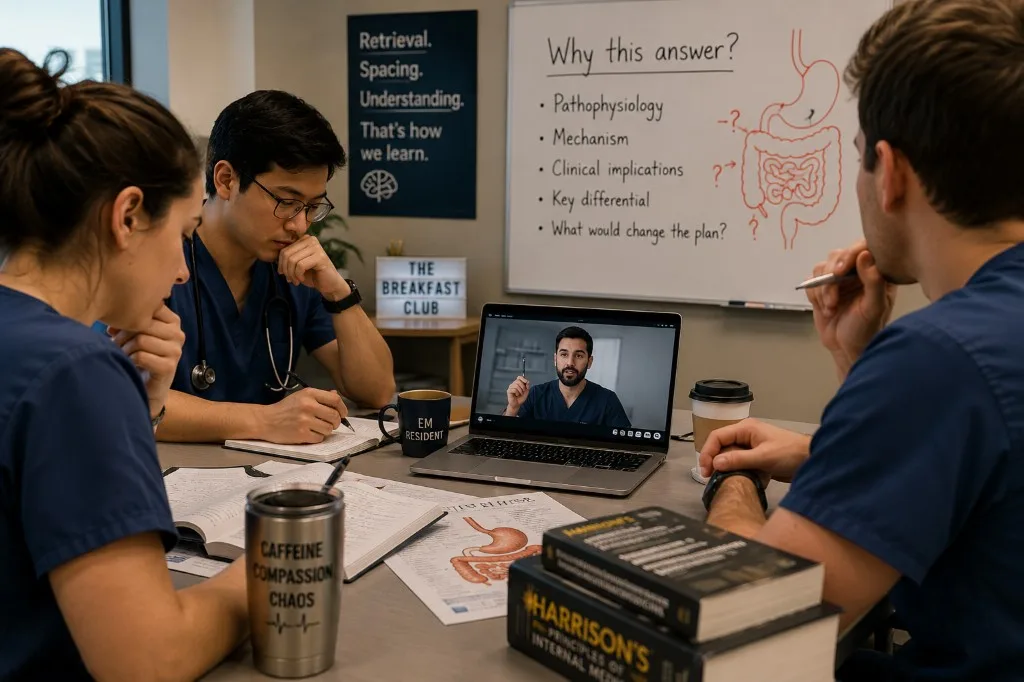
Illustration: collaborative residency study session with retrieval and elaboration themes — conceptual image, not from the cited study.
Short version
Emergency medicine residents learn in one of the most demanding educational environments in medicine. Long shifts, constant interruptions, sleep disruption, and heavy information load leave little time for systematic review.
Against that background, researchers wanted to test whether even one short session built around active retrieval could improve memory and test performance.
In a small pilot project called The Breakfast Club, a group of residents participated in a one-hour virtual learning session that emphasized spaced retrieval and elaborative questioning. According to the abstract, average quiz scores rose from roughly 53% before the session to 77% shortly afterward, and remained above baseline at about 69% on a later follow-up test.
What the researchers did
The study took place within a single emergency medicine residency program.
Researchers organized an optional educational session focused on gastrointestinal pathophysiology. Residents in the intervention group joined a one-hour online meeting led by an instructor.
But instead of using a traditional lecture format, the session focused on active memory use.
Participants were repeatedly asked to retrieve information from memory and explain why their answers made sense. The approach combined two learning strategies commonly discussed in cognitive science research:
- spaced retrieval, where learners repeatedly pull information from memory over time;
- elaborative interrogation, where learners explain reasoning and causal connections instead of memorizing isolated facts.
A control group continued with the standard residency curriculum and did not attend the additional session.
All participants completed a pretest before the intervention. Researchers then compared performance shortly after the session and again later to see whether knowledge gains persisted over time.
Importantly, this was a very small pilot study involving one institution, one subject area, and only seven residents in the intervention group.
What the study found
The authors are careful not to present the results as definitive proof. Instead, they describe the findings as an encouraging signal that retrieval-based teaching methods may help even in high-pressure medical training environments.
Residents who participated in the Breakfast Club session showed the following pattern:
- around 53% before the session;
- around 77% shortly afterward;
- around 69% at delayed follow-up.
In other words, performance improved substantially immediately after the intervention. Some forgetting appeared over time — which is expected in almost any learning situation — but scores still remained higher than the original baseline.
The abstract does not include full statistical details or extensive reporting on the control group, so the results should be interpreted cautiously. Still, the pattern is consistent with broader research on retrieval practice and long-term memory.
Why this matters
The most interesting part of the study may not be the size of the improvement itself, but the practicality of the intervention.
Medical residency schedules are notoriously difficult. Educational methods that require large amounts of additional time or infrastructure are often unrealistic.
This project suggests that even relatively small, low-cost interventions may still have value when they are designed around how memory actually works.
The session required very little infrastructure:
- a small group;
- an instructor;
- well-designed questions;
- and a virtual meeting space.
The broader principle mirrors what many studies on active recall and spaced repetition have already shown:
Repeated attempts to retrieve information from memory are often more effective than passive rereading.
The study also highlights the possible value of explanation-based learning. Asking learners why an answer makes sense may strengthen understanding beyond simple recognition on multiple-choice tests.
What this could mean outside medicine
Although the study focused on emergency medicine residents, the underlying ideas apply much more broadly.
The same principles could potentially help with:
- exam preparation;
- technical education;
- language learning;
- tutoring systems;
- professional certification training;
- and self-directed learning.
The research adds to a growing body of evidence suggesting that learning improves when people actively work with memory rather than repeatedly exposing themselves to information passively.
Even short sessions may matter if they are structured around retrieval, explanation, and repeated engagement with material.
Important limitations
The study has several major limitations.
The sample size was extremely small, involving only seven residents in the intervention group. The research also took place at a single residency program and covered only one medical topic.
Participants volunteered for the extra session, which means they may already have been more motivated than residents who chose not to participate.
In addition, only the abstract was publicly available in the source material used here. Full methodological details, statistical analyses, and deeper control-group comparisons were not accessible.
For that reason, the study should be viewed as an early exploratory pilot rather than strong conclusive evidence.
Final thoughts
The Breakfast Club study suggests that even one carefully structured hour of active retrieval may improve learning performance in demanding educational environments.
But perhaps the most important lesson is broader than medicine itself.
Effective learning does not always require massive platforms, endless lectures, or complicated technology. Sometimes meaningful gains may come from relatively simple changes: asking learners to actively retrieve information, explain their reasoning, and revisit ideas repeatedly instead of only rereading notes.
This is a plain-language summary of: “The Breakfast Club: Enhancing Emergency Medicine Education Through Spaced Retrieval and Elaborative Interrogation Techniques”.
Source: AEM Education and Training (2026).