
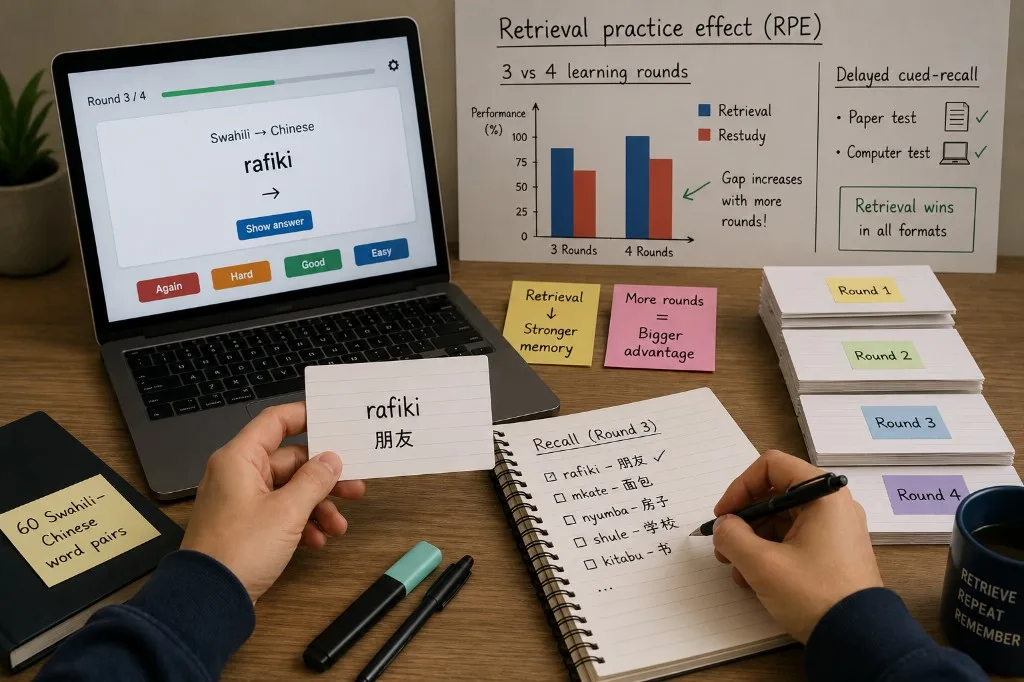
Illustration: vocabulary study with multiple retrieval rounds — conceptual image, not from the cited study.
Short version
Flashcards are often recommended because they encourage active recall — the process of trying to retrieve information from memory instead of simply looking at it again.
A new study suggests that this advantage becomes even stronger when learners go through multiple rounds of recall practice rather than stopping after a single pass.
Researchers found that participants using retrieval-based digital flashcards consistently remembered vocabulary better than those who only restudied the material. More importantly, the gap between the two methods widened as the number of learning rounds increased.
The findings suggest that the power of flashcards may depend not only on whether you use active recall, but also on how many times you repeatedly force memory retrieval.
What the researchers studied
The study, conducted by Huang, Cao, Wang, and Liu, explored two important questions about digital flashcard learning.
First, the researchers wanted to understand whether the number of learning rounds changes the strength of the retrieval practice effect — the well-known advantage of active recall over passive review.
Second, they wanted to test whether retrieval-based learning still helps when the final test happens in a different format from the original study session. In other words, would learning on a screen still transfer to paper-based recall?
The experiment involved 108 Chinese–English bilingual adults.
Participants studied 60 unfamiliar Swahili–Chinese word pairs. Some learned through active recall using digital flashcards, meaning they had to attempt retrieval before seeing the answer. Others mainly restudied the word pairs without retrieval demands.
Different participants completed either three or four rounds of learning.
About 30 minutes later, everyone completed delayed cued-recall tests. Some took the test on paper, while others completed it on a computer.
What the researchers found
The results strongly supported the benefits of retrieval-based learning.
Participants who practiced active recall consistently outperformed those who only restudied the vocabulary. This was true regardless of whether the delayed test happened on paper or on a screen.
That finding is important because it suggests that the benefits of retrieval practice are not tied too tightly to one exact learning environment or device.
But the most interesting result involved the number of learning rounds.
When participants completed more rounds of active recall, the retrieval practice effect became larger. In other words, each additional cycle of trying to retrieve information from memory widened the advantage over passive rereading.
The study suggests that repeated retrieval attempts may strengthen memory progressively rather than producing a one-time benefit.
Why this matters
Many people use flashcard apps almost automatically. They open a deck, flip through cards quickly, recognize familiar answers, and feel productive.
But this study highlights an important distinction:
Flashcards work best when they function as memory tests, not as animated rereading tools.
Simply recognizing information can create a strong feeling of familiarity without necessarily improving long-term retention. Active retrieval is different because it forces the brain to reconstruct the answer from memory.
The study also suggests that one shallow pass through a deck may not be enough to fully benefit from retrieval practice. Additional recall rounds may continue strengthening memory and increasing the advantage over passive review.
Practical implications
For students, language learners, and anyone using spaced repetition systems, the findings point toward several practical ideas.
Instead of rushing through cards once, it may help to:
- complete multiple rounds of active recall;
- avoid revealing answers too quickly;
- occasionally test yourself away from the app;
- write answers by hand from memory;
- focus on retrieval effort rather than speed alone.
The results also suggest that learning transfers reasonably well across formats. Studying digitally did not prevent participants from recalling information later on paper.
For teachers and course designers, the research supports assignments that require repeated closed-book recall rather than repeated exposure to the same material.
Limitations
The study was conducted under controlled laboratory-style conditions using artificial vocabulary pairs rather than real classroom learning over long periods of time.
Participants were bilingual adults, so the results may not generalize perfectly to children, beginners, or different educational settings.
The number of learning rounds was also relatively small — only three or four. It remains unclear whether the retrieval advantage would continue growing indefinitely or eventually plateau after many more repetitions.
In addition, the publicly available abstract provides limited information about very long-term retention beyond the short delayed testing window.
Final thoughts
The study reinforces one of the central ideas in modern learning science:
Memory strengthens more through retrieval than through repeated exposure alone.
But it also adds an important detail: the number of retrieval attempts matters.
Each additional successful recall round may widen the gap between genuine learning and the temporary feeling of familiarity that comes from passive rereading.
For anyone building study habits with flashcards or spaced repetition systems, the message is simple:
The real power of flashcards is not flipping through them — it is repeatedly forcing memory to work.
This is a plain-language summary of: “The Moderating Role of Learning Rounds: Effects on Retrieval Practice and Context Dependence in Digital Flashcard Foreign Language Vocabulary Learning”.
Source: Behavioral Sciences (2025).