
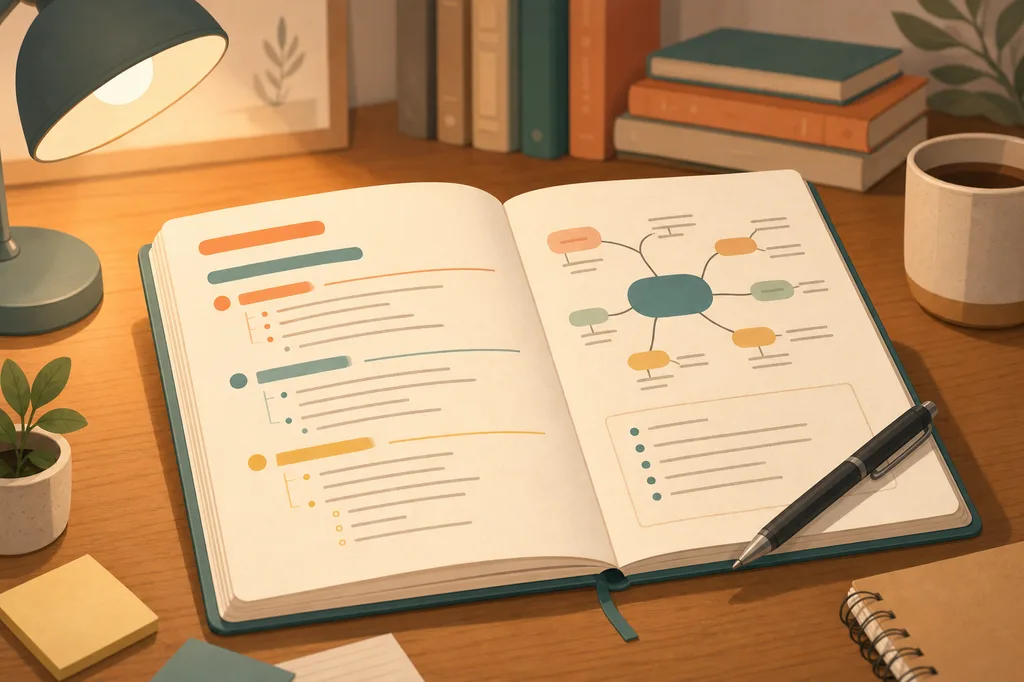
Most people take notes the way school taught them: copy what the teacher says, highlight the textbook, file it away. Months later the notebook is useless — too long, too literal, no structure. Good notes are not a transcript. They are a compressed map of ideas you understood, phrased in your own words, ready for recall.
Key takeaways
Notes fail when they duplicate the source — word-for-word copying trains recognition, not understanding or recall.
The best note is one you can use without the original — hierarchy, main ideas, your phrasing, examples, and self-test questions.
Method matters less than habits — own words, structure, links, and a review loop beat fancy layouts you abandon.
Notes are encoding; cards and quizzes are retention — pair Cornell or outlines with questions and intervals (complete memory guide).
Paper, digital, or hybrid — choose what you will actually maintain; search and links favor digital, focus favors paper for some learners.
Introduction: why most notes do not work
Notes as thinking, not rewriting
Note-taking is often treated as documentation: capture everything so nothing is “lost.” But the brain does not learn by storage — it learns by processing. When you paraphrase, rank ideas, and ask questions, you engage working memory and link new material to what you already know. That is the generation effect: information you produce yourself sticks better than text you only read or copy.
A useful mental model: the lecture or chapter is raw ore; the note is refined metal — smaller, denser, shaped for use.
Who this guide is for
School and university students facing lectures, textbooks, and exams. Self-learners reading books, courses, and documentation. Professionals building a personal knowledge base from articles, standards, and meetings. Language learners who need vocabulary and grammar in retrievable form. Anyone who has folders of “notes” they never reopen.
What changes when you note-take well
You understand faster because you must decide what matters. You remember longer when notes become questions and spaced reviews. You find information months later through headings and links instead of scrolling a wall of text. Exam prep shifts from rereading a hundred pages to drilling a tight question bank — see also exam prep without forgetting.
Why notes help you learn
How memory interacts with notes
Sensory and short-term memory hold information for seconds unless you attend to it. Working memory is a small desk — four to seven chunks at once. Dumping a lecture verbatim overloads the desk; you write but do not encode deeply.
Long-term memory needs meaningful links and reactivation. Notes help at encoding (first pass) and at retrieval cues (headings, questions, diagrams you rebuild from). They do not replace retrieval practice: rereading notes still mostly trains recognition (how the brain works during learning).
Active processing — summarizing, questioning, diagramming — beats passive transcription. Studies on learning strategies consistently show students know that rereading and highlighting are weak, yet default to them because they feel easy (Carpenter and Sanchez survey).
Notes as a tool for understanding
Structure forces you to see parts and whole: main claim, support, exceptions. Selecting main ideas is the same skill as critical reading — what is asserted vs illustrated vs assumed (critical thinking guide). Linking concepts (“mitochondria → ATP → muscle fatigue”) builds a network, not isolated facts. That network is what you want on exam day and at work.
Main mistakes when taking notes
Copying the textbook word for word
You get a shorter book, not understanding. Your eyes move; your brain idles. Worse: you confuse familiarity with mastery — the text feels known because you have seen it on your page.
Excessive detail
Every date, every name, every footnote — “just in case.” Result: noise hides signal; you cannot scan before an exam. Rule of thumb: if you cannot explain why a detail matters, it does not belong in the first pass.
No structure
A continuous paragraph without headings is a graveyard for ideas. Without hierarchy you cannot skim, cannot quiz yourself per section, cannot merge with other topics.
Notes without follow-up review
A notebook written once and never reopened decays like unreviewed flashcards. Encoding without spacing and recall follows the forgetting curve — see memory complete guide.
Fancy formatting over content
Color codes, seventeen highlighter shades, perfect calligraphy — hours on aesthetics, minutes on meaning. Format serves scanning and recall, not Instagram.
Trying to capture everything
Lectures and chapters are infinite; your working memory is not. Selective notes beat complete transcripts. Miss a point? You can fill the gap after class from slides or a peer — you cannot recover a hour of shallow copying.
What a good note should do
A strong note set should let you:
- Restore the material quickly — scan headings and bullets, not reread the course.
- Prepare for exams or work — each section yields questions you can answer closed-book.
- Build a personal knowledge base — ideas accumulate across courses and years.
- Search months later — titles, tags, and links beat memory of “which notebook, which page.”
If your notes cannot do at least two of these, the method — not your ability — needs adjustment.
Core principles of effective note-taking
Write in your own words
Paraphrase until you could explain to a friend without looking. If you must quote, mark it and add why it matters.
Highlight what matters
One main idea per section. Use bold or a margin mark for “if I remember only one thing…”
Use hierarchy
## topic → ### subtopic → bullets. Numbered steps for procedures; bullets for lists of properties.
Create links between ideas
Explicit bridges: “This contradicts…”, “Example of…”, “Prerequisite:…”. In digital tools, [[wikilinks]] or tags; on paper, margin arrows.
Add examples and glosses
Abstract definition + one concrete example you invented. Define jargon once in plain language.
Keep it compact
Aim for 10–30% of source length for first-pass notes. Compression is the skill.
Popular note-taking methods
Cornell method
Page layout
Divide the page: wide right column for notes during class; narrow left column for cues/questions after; bottom strip for summary.
Step by step
- During the lecture: phrases, not sentences; abbreviations OK.
- Within 24 hours: left column — keywords and questions per block.
- Bottom: 3–5 sentence summary of the whole page.
- Cover the right column; answer questions from the left (active recall).
Example (biology fragment)
| Cues (left) | Notes (right) |
|---|---|
| What is photosynthesis? | Plants convert light → chemical energy; inputs: CO₂, water, light; output: glucose + O₂ |
| Where in cell? | Chloroplasts; chlorophyll absorbs light |
| Why O₂? | Byproduct of splitting water |
Summary: Photosynthesis stores solar energy in sugar in chloroplasts; oxygen is released when water is split.
Pros and cons
Pros: built-in review column; exam-friendly; works on paper. Cons: slow for fast speakers unless you abbreviate heavily; weak for highly visual topics unless you add sketches.
Structured outline method
When it fits best
Textbooks, articles, recorded lectures you can pause, any material with clear headings.
Tree example (history)
Cold War origins
├── Post-WWII Europe
│   ├── Division of Germany
│   └── Soviet buffer states
├── Ideological conflict
│   ├── Capitalism vs planned economy
│   └── Nuclear deterrence
└── Early crises
    ├── Berlin blockade
    └── Korean War
Typical mistakes
Copying the book’s headings without rewriting content; outline so deep that every line is a heading with no flesh; no questions at leaves.
Mind maps
What they are
A central concept with branches for subtopics, examples, and links. Color and icons optional; topology (what connects to what) is the point.
Building links
Start center → first-level branches (max 5–7) → details on outer twigs. Use arrows for cause-effect. One map per lecture or one map per unit — not one giant map for a whole subject unless you maintain it over months.
Best subjects
Biology pathways, literature themes, project planning, brainstorming essay arguments. Weaker for dense math proofs unless combined with numbered steps on the side.
Question-and-answer method
Turn each heading into a question: “What three factors…?” Answer on the next line or on a flashcard. This is the bridge to Anki and self-testing — see DEAME flashcard design. Notes become a question bank; exam prep is answering, not rereading.
Tables
Use when comparing entities: hormones, programming paradigms, historical treaties, grammar tenses. Rows = items; columns = attributes. A table beats prose when readers need at-a-glance contrast; avoid tables for narrative or causal chains — use outline or map.
Notes during live lectures
Before class
Skim the syllabus or previous chapter; write 3 questions you hope the lecture answers. One blank Cornell page or outline skeleton ready.
During the lecture
Capture structure first — numbering as the speaker moves (“II. Causes → A. Economic”). Facts only if they support the structure. Mark ? for gaps; do not stop the flow to perfect a sentence.
Spotting the teacher’s key points
Repeated phrases, “this will be on the exam,” slower pace, board content, summaries at end. Contrast (“unlike X, Y…”) is often exam gold.
Right after class (10–20 minutes)
Fill ? gaps while memory is fresh. Add left-column cues (Cornell) or questions (outline). One-sentence “what was this lecture about?”
Processing rough notes
Rewrite illegible bits; merge duplicate points; cut trivia; add one example per abstract block. This second pass is where understanding happens — not during frantic typing.
Notes from books and articles
Set a reading goal
Exam? Professional application? Curiosity? Goal decides depth: exam → definitions + links + questions; exploration → ideas and quotes with commentary.
Extract the author’s main ideas
Per chapter: thesis in one sentence, 3–5 supporting moves, what evidence type they use (data, case, theory). Skip digressions on first pass.
Record conclusions, not quotes
A quote without your gloss is inert. Prefer: “Author argues X because Y; I think Z is weak because…”
Add your own comments
Agreement, doubt, link to another book, “apply at work by…”. These comments become the most valuable part years later.
Short summary after reading
Half page max: what you learned, what you disagree with, what to do next (questions, project, cards).
For scientific papers, also note method, sample, limitation — same layers as critical reading (ThinkLens can mirror that structure on a paragraph).
Paper vs digital notes
Paper advantages
Fewer distractions; sketching and spatial layout natural; some studies suggest handwriting may deepen encoding for certain learners. Good for exams that allow handwritten cheat sheets you built yourself.
Digital advantages
Search, backup, sync, links between notes, easy export to cards. Scales across years and projects.
Hybrid approach
Lecture on paper (speed + focus) → photo or summary into Obsidian/Notion same day. Reading on digital with highlights exported into a summary note. Cards always digital for spacing algorithms.
Choose the combo you will sustain weekly — not the one that looks most productive on YouTube.
Tools for note-taking
| Tool | Strengths | Watch out for |
|---|---|---|
| Notebook | Zero friction, focus | No search; archive strategy needed |
| Markdown files | Portable, version control, future-proof | You build structure yourself |
| Obsidian | Links, graph, local files, plugins | Setup rabbit holes |
| Notion | Databases, sharing, templates | Can become busywork |
| OneNote | Freeform pages, ink, Microsoft ecosystem | Weak linking vs Obsidian |
| Personal wiki / PKM | Long-term knowledge base | Requires maintenance habit |
No tool fixes passive copying. Process first, tool second.
Turn notes into a learning system
Spaced repetition
Schedule reviews: day 1, day 3, week 1, month 1. Calendar or app — the schedule matters more than the app brand (memory guide).
Active recall over rereading
Close the note; list everything you remember; check; rewrite gaps. Convert weak sections to flashcards.
Cards from notes
One card per atomic question from your cue column. Follow DEAME: one fact per card, meaningful question, avoid lists of seven items on one card.
Knowledge network
Link lecture notes to book notes to project notes. Tags: #exam-may, #work-client-x. The graph is how professionals think in public with themselves.
Notes for different contexts
School
Focus on examinable structure; cooperate with friends to compare “what did we each think was main?” Keep one master outline per subject per term.
University
Faster speakers → abbreviations + same-day processing. Seminars: notes on arguments, not only facts. Labs: method + results + “what could go wrong.”
Languages
Tables for grammar; example sentences you composed; vocabulary with collocation, not isolated words; audio note for pronunciation if helpful.
Programming
Concept outline + minimal code you typed yourself + link to repo commit. Copy-paste from docs without running code is weak encoding.
Professional development
One note per book/article: 5 bullets + 1 action for work. Quarterly review of “ideas I meant to apply.”
Scientific articles
PICO-style or IMRaD skim: question, methods, findings, limits, relevance to your project. Never archive PDFs without a one-page note — you will not reread fifty PDFs.
Bad vs good note: same material
Topic: why spaced repetition beats cramming.
Bad version
Spaced repetition is when you review material at increasing intervals. Ebbinghaus found the forgetting curve. Cramming is bad. Anki is an app. Students should review often. Memory works by neurons. Sleep is important.
Wall of assertions; copied tone; no structure; no questions; cannot scan; cannot self-test.
Good version
## Spaced repetition vs cramming

**Main idea:** Memory strengthens when you *retrieve* just before you would forget — not when you reread everything once.

### Mechanism
- Forgetting curve: sharp drop days 1–3 without recall
- Retrieval practice > rereading (testing effect)

### Practice
- After first learn: recall at 1 d, 3 d, 7 d, 14 d
- Cramming = recognition without durable trace

### My questions
- Why does retrieval beat rereading?
- Minimum viable interval for my exam date?

### Example
Exam in 30 days → map topics to calendar slots, not one 8 h block.
Why the second works
Hierarchy, one main idea, own phrasing, mechanism + practice split, self-questions, concrete example. You can close the page and still study.
Checklist: an ideal note
- Understandable one month later without the source
- Clear structure and headings
- Main ideas visually marked
- Your words, not pasted paragraphs
- At least one example per abstract block
- Self-test questions (margin or bottom)
- Compact — no transcript padding
FAQ
Should I type or handwrite lectures?
Handwrite if it keeps you selective; type if the speaker is too fast — but then process same day. Speed without processing is useless.
How long should notes be?
Rough guide: 10–30% of lecture length for a first pass; shorter after you add questions and cut noise.
Cornell or mind map?
Cornell for fast linear input + review; mind map for relationship-heavy topics. Many students use outline in class, map at home.
Are highlighters useful?
Highlighting alone is weak; highlighting then writing a margin note in your words helps slightly. Do not rainbow the whole page.
Digital notes for exams that ban devices?
Process digitally for cards and search; keep one exam outline on paper you rebuild weekly from recall.
Can AI take notes for me?
AI summaries help orientation if you still retrieve and verify. Passive consumption of bot notes = same fluency illusion as copying the textbook.
Conclusion
Note-taking is processing, not filing. The best note is the one that lets you reconstruct the idea without the source — through structure, your language, examples, and questions. Fancy systems fail when unused; a simple Cornell or outline reviewed on a schedule beats a perfect Notion vault you never open.
This week: pick one lecture or one chapter. Take notes with hierarchy and questions; next day, close them and recall; turn five gaps into cards. In seven days you will feel the difference between a transcript and a tool.