
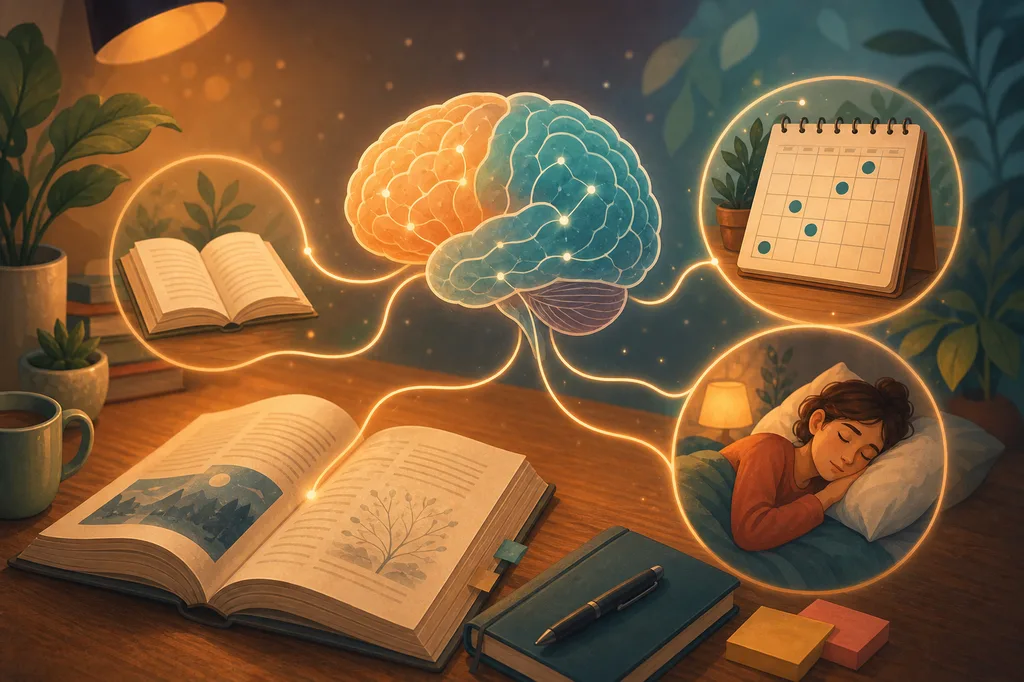
When you study, something more interesting than “information goes in” is happening. Networks across your brain are deciding what to keep, what to discard, and when to make a memory easier to find again. Understanding those decisions — even at a high level — helps you choose methods that match how memory actually works instead of how studying feels.
Key takeaways
Learning is change in the brain, not filing. New knowledge rewires connections between neurons. What you remember depends on how strongly those connections were formed and how often they are reactivated.
Attention is the gate. If working memory is overloaded or distracted, encoding is shallow. Breaks, sleep, and simpler tasks at the right moment are not laziness — they are part of the biology.
Retrieval strengthens memory more than re-exposure. Trying to recall — even struggling — signals the brain that a trace matters. That is the logic behind quizzes, flashcards, and self-testing.
Time and sleep are ingredients, not optional extras. Consolidation continues after you close the book. Spacing sessions and sleeping between study days give the brain windows to stabilize and integrate what you learned.
Feelings mislead. Fluency after rereading feels like mastery. Difficulty during recall feels like failure. Both feelings are poor guides to long-term retention.
What “learning in the brain” actually means
Colloquially we say we “learned” something when we can use it later — on a test, in conversation, at work. Neuroscience describes the same outcome differently: durable changes in neural circuits that make a skill or fact easier to activate.
Those changes happen at several levels. Synapses — the junctions between neurons — can become stronger or weaker. Patterns of firing can shift. Networks linking sensory input, meaning, and action can bind together. None of this is instant. A single intense cram session may leave a fragile trace; repeated activation across days builds something sturdier.
For students, parents, and teachers, the useful translation is simple: the brain learns what it pays attention to, repeats, and successfully retrieves under modest challenge. Everything else — bold highlights, passive videos watched once, copied notes — may help a little, but often creates familiarity without durable memory.
Why brain mechanisms matter for study choices
Many popular study habits optimize for comfort in the moment: smooth rereading, neat highlighting, long passive review. The brain’s consolidation machinery optimizes for something else — useful traces that survive delay.
That mismatch explains a recurring finding in education research: students often know about effective strategies yet avoid them because they feel harder (our survey summary). Retrieval practice feels slow. Spacing requires planning. Interleaving mixes topics and feels messy. All of those friction points are signs the method is asking the brain to do real work — which is often exactly what strengthens memory.
Understanding mechanisms also prevents superstition. “Brain training” games, learning styles myths, and miracle schedules sell simplicity. Evidence-informed learning respects biology without pretending one trick fixes every subject.
How memory forms: encoding, consolidation, retrieval
Memory is not a single box. Psychologists and neuroscientists describe at least three overlapping phases.
Encoding: getting information in
Encoding is the first pass — linking new material to what you already know. It depends heavily on attention and working memory, the small mental workspace where you hold and manipulate ideas right now. If that workspace is crowded (too many new terms at once, phone notifications, anxiety about the clock), encoding stays shallow.
Deep encoding happens when you elaborate: explain in your own words, connect to examples, ask why something is true, or imagine using it. That is why self-explanation and teaching others help — they force meaningful links, not just visual exposure.
Consolidation: stabilizing traces over time
Consolidation is the offline work — much of it during sleep — that stabilizes and reorganizes memories. Lab studies and classroom research both suggest that sleep after learning improves retention compared with equal time awake without sleep. Consolidation also integrates new knowledge with older schemas, which is why prior knowledge accelerates learning in familiar domains and slows it in totally foreign ones.
This phase is easy to sabotage. Cramming all night before an exam may leave enough for tomorrow’s test but weakens the long arc. Short brain breaks during study can protect attention for the next encoding bout without pretending breaks alone replace effort.
Retrieval: the memory workout
Retrieval is pulling information back out — on a quiz, in a conversation, on a flashcard. Counter-intuitively, successful retrieval strengthens the memory more than seeing the answer again. That testing effect appears in dental education, medical training, and school classrooms alike — low-stakes quizzes after lectures predict better final-exam performance on tested topics than on material only reread.
Retrieval also updates memory: each successful recall can make the trace more accessible and more aligned with how you will need it later. Failed retrieval, followed by feedback, can be powerful too — it marks a gap the brain may prioritize fixing.
Attention, effort, and cognitive load
Your brain has limited bandwidth in the moment. Cognitive load theory distinguishes intrinsic load (inherent difficulty of the material), extraneous load (poor presentation, split attention), and germane load (effort devoted to building schemas). Good teaching and good self-study reduce extraneous load so more capacity goes to germane work.
Attention fluctuates. Long blocks without variation lead to mind-wandering — not moral failure, but predictable biology. Shorter sessions, variation, and deliberate breaks can reset focus. Neurodidactic training for medical interns explicitly pairs neuroscience basics with study methods for that reason: when learners understand why spacing and retrieval help, they tolerate the effort better.
Emotional state matters too. Moderate stress can sharpen focus; chronic anxiety narrows attention and can interfere with retrieval during exams. Designing low-stakes practice — quizzes where mistakes are data, not verdicts — reduces the threat response that blocks recall.
Spacing, sleep, and the “eligibility window”
One of the most robust findings in learning science is the spacing effect: distributing practice over days beats massing the same total time into one block. You see it in flashcard apps, simulator training, and classroom schedules.
Why spacing works is still debated, but plausible mechanisms include forgetting and relearning (each return requires retrieval, which strengthens memory), consolidation between sessions, and context variation (slightly different moods, places, or problem types make memory more flexible).
Recent neuroscience adds a vivid detail. In multiday training experiments on simple marine circuits, a second training block about 24 hours after the first amplified long-term synaptic change — but the same block at 18 or 32 hours did not. Competing transcription factors (including CREB family proteins) appear to act like a cellular timer, opening a narrow eligibility window for a follow-up session to boost memory.
Humans are not sea slugs, but the lesson rhymes with spacing advice: the brain may be especially ready for a second meaningful pass after a day — not five minutes later, not a week late without refresh. Pair that with sleep, and you align study habits with timing biology rather than calendar panic.
Research and evidence: what we know and what we should not overclaim
Evidence-informed learning is a patchwork, not a single formula.
Strong support: retrieval practice / testing effect; spaced practice; interleaving in many skill domains; sleep’s role in consolidation; the gap between perceived fluency and actual retention.
Mixed or context-dependent: exact optimal gap between sessions (depends on material, learner, retention interval); whether very long spacing always beats moderate spacing in motor skills (laparoscopy simulator study found similar outcomes with 1–2 day vs 6–8 day gaps); tool-specific claims (Anki helps on some standardized exams more than on every course test — see systematic reviews emerging in medical education).
Weak or oversold: learning styles as rigid categories; “right brain / left brain” study plans; passive re-exposure alone; commercial “brain boost” products without transfer evidence.
HiddenLogic’s research posts translate individual papers into plain language; this guide situates them in the bigger picture. When a headline says “scientists proved X,” ask: who, how long, what outcome, and what comparison group.
Benefits for learners, parents, and teachers
When you treat learning as brain-aligned process design, practical wins appear.
Learners waste less time on theatrical studying. A 25-minute retrieval session plus sleep often beats three hours of rereading for next-week retention.
Parents can coach process instead of policing hours: “What did you try to remember without looking?” beats “Did you read it again?”
Teachers can embed low-stakes retrieval after lessons — brief quizzes with feedback — without turning every class into high-pressure testing. Emotional engagement moderates how much testing helps; supportive framing matters.
Tool builders (flashcards, apps, AI tutors) can reduce friction for spacing and retrieval rather than replacing them with smoother passive flows.
Limitations, myths, and honest uncertainty
Brain science for learners is simplified by necessity. Human memory experiments rarely track individual synapses; animal work is precise but distant from your history exam. fMRI pictures are suggestive, not prescriptions.
Common myths to drop:
- Myth: You only use 10% of your brain. Reality: You use the whole organ; tasks recruit different networks.
- Myth: Everyone has a fixed learning style that must be matched. Reality: Preferences exist, but matching styles has weak evidence as a universal rule.
- Myth: Cramming “works” if you pass tomorrow. Reality: It often works for immediate tests and fails for durable competence.
- Myth: More hours always equals more learning. Reality: Diminishing returns, sleep debt, and poor method choice cap the value of raw time.
Individual differences — attention disorders, anxiety, prior knowledge, language load — mean universal schedules fail. Neurodiversity research also shows retrieval practice is understudied in many disabled learner groups (research gap summary); promising methods still need inclusive evidence.
Practical applications: a brain-aligned week of study
You do not need a laboratory to apply the cycle.
Day 1 — Encode with focus. Preview the topic lightly, then study in chunks of 20–40 minutes with one goal per chunk. Explain a subsection aloud or in writing. Reduce phone extraneous load.
Same day — Retrieve once. Close the book. Write or recite what you remember. Check and fix errors. This is your first retrieval, not your last.
Day 2 — Space and interleave. Before new material, spend ten minutes recalling yesterday’s topic. Mix problem types if skills are involved.
Before sleep — Stop at a sensible hour. Consolidation needs rest more than one extra bleary hour.
Day 3–7 — Short retrieval reps. Flashcards, practice questions, or teach a peer. Increase interval if recall stays easy.
Before high-stakes tests — Simulate retrieval conditions. Practice questions under time pressure after you have built traces with spaced recall — not instead of it.
If you use digital tools, prefer systems that schedule reviews and force recall (Anki usage patterns in medical students show how deeply such tools embed in real routines — with both benefits and lifestyle trade-offs).
Common mistakes
Confusing recognition with recall
Rereading makes text look familiar. Exams usually require recall. Train recall early.
Spacing without retrieval
Spreading passive rereads across days helps less than spreading attempts to remember.
Ignoring sleep for “one more chapter”
Sleep debt impairs attention the next day and disrupts consolidation. The trade rarely pays off beyond cram-scenarios.
All difficulty, no feedback
Hard retrieval without correction can reinforce errors. Check answers, adjust cards, fix misconceptions.
Tool worship
Apps do not replace strategy. A perfect flashcard deck used once a month loses to a modest deck used with honest spacing.
FAQ
Does multitasking while studying work?
For demanding material, usually no. Divided attention increases extraneous load and shallow encoding. Light automatic tasks during rote review may feel fine but rarely build deep knowledge.
Is highlighting ever useful?
As a first pass to mark structure, sometimes. As a primary strategy, it often underperforms retrieval. Highlight less; quiz more.
How long should study sessions be?
There is no magic number. Many people do well with 20–45 focused minutes, a short break, then another block — especially for adolescents with shorter sustained attention spans.
Why does forgetting feel like failure?
Forgetting is normal. It also creates spacing opportunities: slightly forgotten material, successfully retrieved, can be strengthened more than material that never left working memory.
Can AI replace active study?
AI can explain, generate questions, and simulate tutoring — useful if you still retrieve and verify. Passive AI summaries risk the same fluency illusion as passive rereading. Use AI to prompt recall, not replace it.
Does music help?
Depends on the task and the music. Complex lyrics often compete with verbal material. Instrumental or familiar low-attention background may be neutral or mildly helpful for some people — test honestly with retrieval, not vibes.
What about children?
The same cycle applies; session length and language load shrink. Playful retrieval, spaced stories, and sleep routines matter enormously in early years (preschool retrieval practice).
Is stress always bad for learning?
Acute moderate stress can focus attention; chronic stress and test panic harm retrieval. Low-stakes practice reduces threat.
How does this connect to critical reading?
The same brain machinery applies: you remember claims you actively reconstruct, not headlines you skim. See the critical thinking complete guide for textual discipline that parallels memory discipline.
Further reading
These HiddenLogic posts drill into specific mechanisms and studies:
- Students know effective strategies but avoid them — effort and emotion, not ignorance
- Brain breaks, attention, and classroom learning
- Neurodidactic internship curriculum
- Testing effect and neurodiversity research gap
- Anki usage patterns among first-year medical students
- Critical thinking complete guide
Conclusion
Your brain during learning is not a passive bucket. It is a selective, timing-sensitive system that strengthens what you attend to, revisit, and successfully pull back under challenge — especially after sleep and sensible spacing.
This week, pick one topic you care about. Study it once with focus, retrieve it once without notes, sleep, then retrieve again twenty-four hours later. Notice the difference in effort — and, a week later, in what still lives in memory. That small experiment teaches the neuroscience better than any diagram alone.