
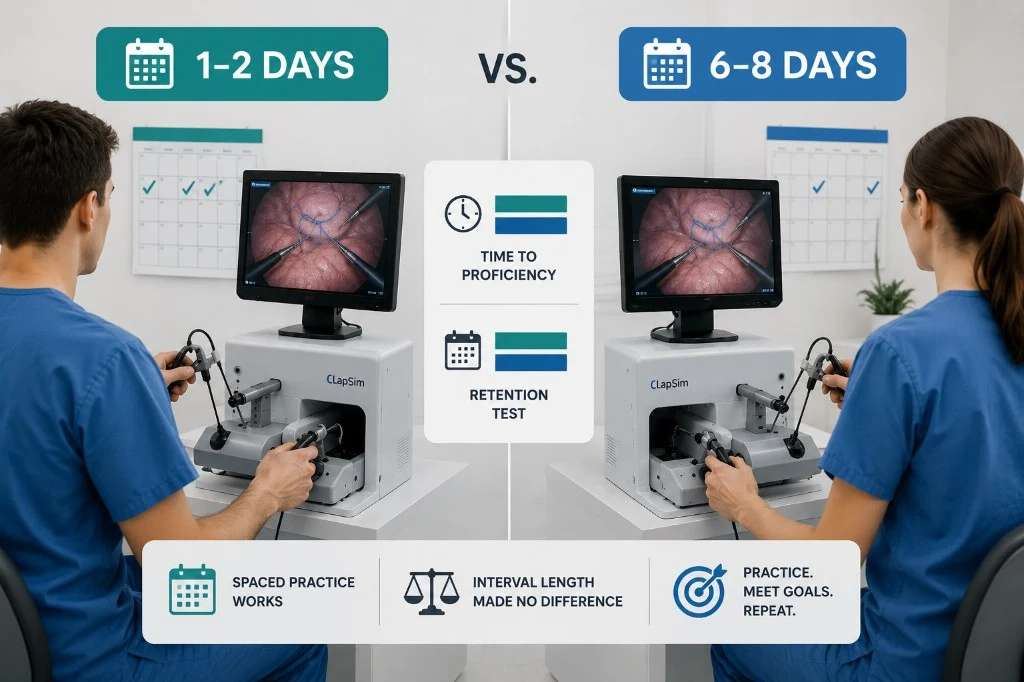
Illustration: distributed laparoscopy simulator practice and session spacing — conceptual image, not from the cited study.
Short version
Spacing practice over time is usually better than cramming everything into one intense session. That finding appears again and again across learning research.
But an important question remains: how long should the gap between sessions actually be?
In this study, medical students trained on a laparoscopy simulator with either short pauses between sessions (1–2 days) or longer ones (6–8 days). In the end, both groups improved at almost the same pace and performed similarly weeks later on a follow-up test.
What the researchers studied
Simulation training has become a standard part of surgical education. Before working with real patients, students can practice movements and procedures safely in a virtual environment.
Many training programs recommend distributed practice — spreading sessions across time instead of packing everything into a single marathon. Sleep and memory consolidation are often cited as reasons why spacing may help both learning and motor skills.
Still, researchers are not fully sure what the best interval is. Some earlier studies suggested that after longer breaks, learners may need extra time to “reactivate” previously learned skills.
Tang and colleagues tested this idea in a randomized trial in Copenhagen involving 39 medical students. Participants trained on the LapSim® virtual-reality simulator and continued practicing until they reached predefined proficiency targets.
One group trained with pauses of roughly 1–2 days between sessions. The other trained with intervals closer to a week.
After completing the curriculum, students returned again 3–5 weeks later for a retention test to see how well the skills held up over time.
What they found
The differences between groups were surprisingly small.
Students in the short-interval group reached proficiency in about 291 minutes on average, while the longer-interval group needed around 299 minutes. Statistically, that difference was not meaningful.
The same pattern appeared during the retention test weeks later. Both groups regained proficiency much faster than during the original training period, suggesting that the earlier learning had largely stayed intact.
Requests for instructor feedback were also similar between groups.
In other words, spacing still mattered — but within this range, the exact number of days between sessions did not appear to change outcomes very much.
What this could mean in practice
The study is reassuring for learners with busy schedules.
It suggests that when practice is consistent and goal-directed, the exact calendar spacing may matter less than many people assume. Missing the “perfect” study interval by a few days may not destroy progress.
That does not mean spacing is useless. The broader research literature still generally supports distributed practice over cramming. But this trial hints that there may be flexibility inside a reasonable spacing window.
The results also highlight something many learners experience: after a break, skills often return much faster than they were learned the first time. Feeling rusty does not necessarily mean the original training failed.
Limitations
This was a relatively small study from a single training center, with 35 students completing the full protocol.
Researchers only compared two spacing ranges — 1–2 days versus 6–8 days. They did not test same-day repetition, month-long gaps, or more complex schedules.
The findings also apply specifically to laparoscopic simulator training, not automatically to flashcards, classroom learning, language study, or real surgical performance.