
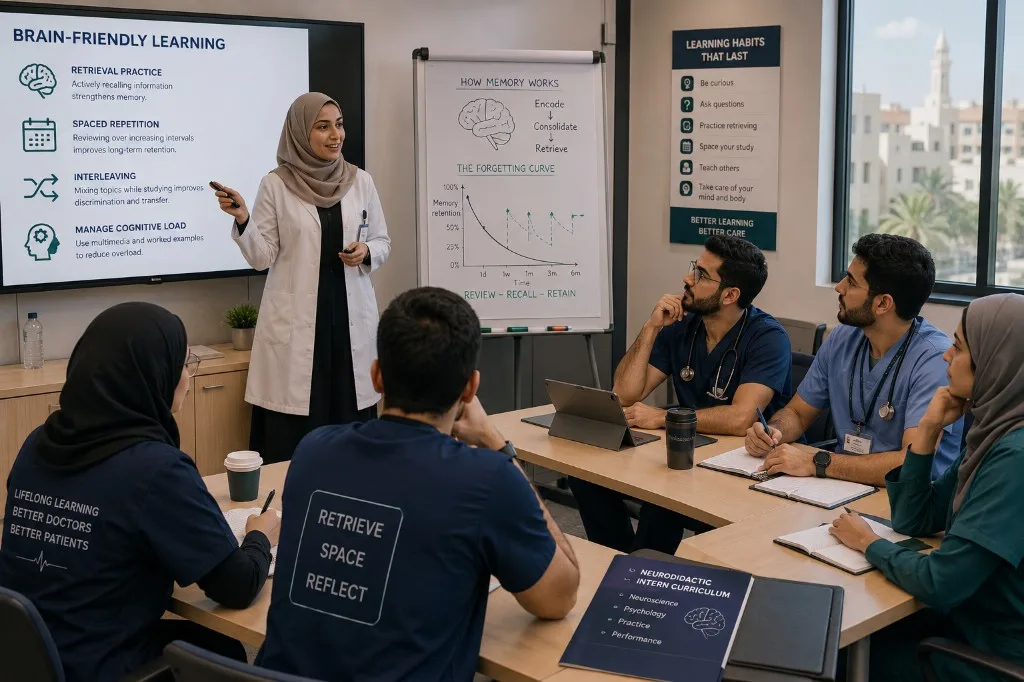
Illustration: internship curriculum built around retrieval practice and spaced repetition — conceptual image, not from the cited study.
In one sentence
A one-cohort program that explicitly taught retrieval practice, spaced repetition, and related study strategies was linked to higher engagement, lower perceived stress, and better clinical ratings among medical interns.
What the researchers did
Internship is a high-pressure bridge between textbooks and real patients. The team co-developed a curriculum blending behavioral neuroscience and educational psychology — ideas about how memory, emotion, and motivation interact with how people study.
Modules included evidence-based tactics such as retrieval practice, spaced repetition, and interleaving, plus multimedia designed to manage cognitive load, metacognitive coaching, mindfulness exercises, and team communication simulations.
One hundred interns in Saudi Arabia completed pre- and post-program surveys (Arabic versions) on cognitive engagement, emotional resilience, and stress. Faculty rated clinical skills with workplace-based assessments (mini-CEX). Focus groups captured qualitative feedback.
The design was pragmatic and longitudinal within a single cohort — not a randomized controlled trial.
What they found
Reported cognitive engagement increased (authors cite an average gain of about 12.4 points on their scale, statistically significant).
Emotional resilience scores also rose (about +8.7, statistically significant).
The share of interns reporting high perceived stress fell from about 48% to 32% (statistically significant).
Faculty ratings of clinical competency improved with a medium effect size (authors report η² ≈ 0.35, statistically significant).
Focus groups highlighted appreciation for concrete study techniques and team communication practice.
What this means for learners and educators
The program treats study skills as trainable clinical infrastructure, not a personal weakness. Naming retrieval and spacing explicitly may help interns adopt habits that match how memory actually works.
For program directors, the results support piloting short, repeated modules during internship rather than assuming trainees will discover effective methods alone.
Pairing these lessons with tools students already use — flashcard apps, question banks, spaced schedules — could reinforce the same principles outside the classroom.
Limitations and what we don't know yet
Without a parallel untreated cohort, causal claims remain cautious. Survey and rating changes could reflect attention, novelty, or seasonal workload shifts.
Long-term retention of clinical knowledge was not the primary endpoint. Cultural and institutional context in one country may limit transfer elsewhere.
Randomized trials with delayed testing would clarify how much of the benefit comes from specific strategies versus general support during a difficult year.