
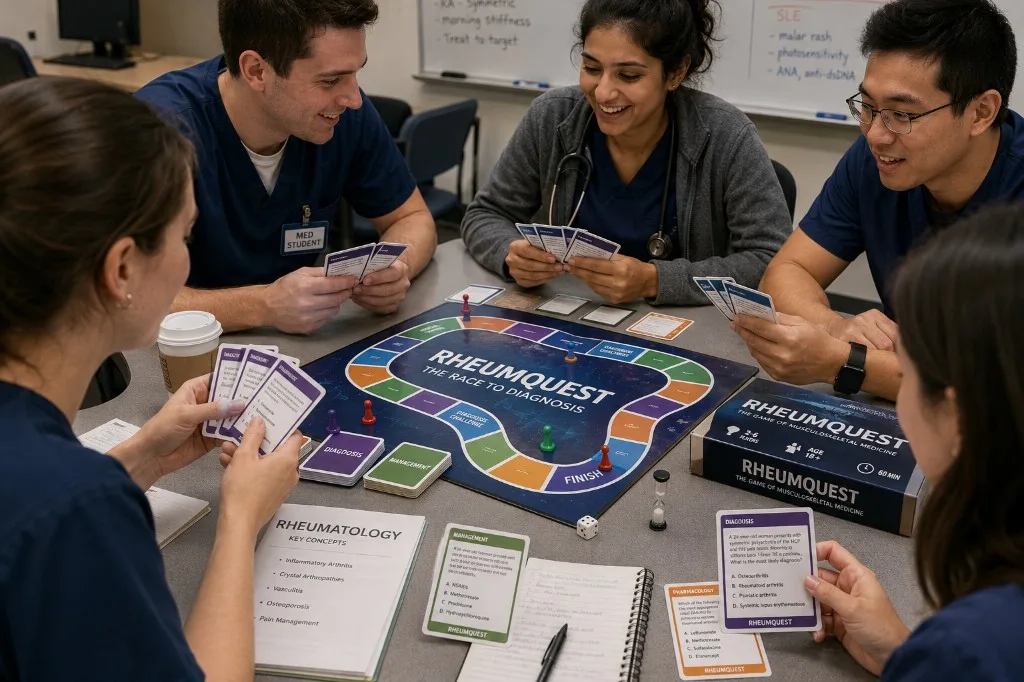
Illustration: gamified flashcard session with board-game mechanics — conceptual image, not from the cited study.
In one sentence
Medical students playing a competitive board game with flashcard-style clinical questions showed a small but statistically significant knowledge gain and higher confidence after a single required hour.
What the researchers did
Musculoskeletal topics are easy to under-teach in crowded clerkships. The authors created RheumQuest, a board game with flashcard-like question cards that link clinical presentations to diagnosis and initial management.
Third-year students on an internal medicine rotation took part in a required, formative one-hour small-group session. Teams advanced on the board by answering questions correctly; the first team to finish won.
Before and after the session, students completed confidence surveys and a short multiple-choice test (up to 10 points per block). 125 students participated, and all completed both surveys.
What they found
Mean knowledge scores increased from about 7.47 to 7.82 out of 10 (roughly +0.36 points, statistically significant).
Self-reported confidence improved for pharmacology, diagnosis, and management (each comparison statistically significant).
Students described the format as engaging. Authors note the materials are relatively low-cost, reusable, and adaptable to other schools.
What this means for learners and educators
The effect size on test scores is modest — this is not a replacement for clinical exposure or deliberate spaced practice over weeks. But the session combines active recall, peer competition, and immediate feedback in a format many students enjoy.
For educators, the model may work best as a capstone review after core content, similar to other flashcard board games published for endocrine topics.
Flashcard mechanics inside a game can prime retrieval practice; repeating the same cards on a schedule afterward would align the activity more closely with spacing research.
Limitations and what we don't know yet
A single institution, one session, and no long-term follow-up limit generalizability. Without a no-game control group in the reported design, part of the gain could reflect recent studying or test familiarity.
The study does not measure spaced repetition directly — cards were used once in class, not on an interval schedule.
Replication with delayed tests would show whether the boost persists.