
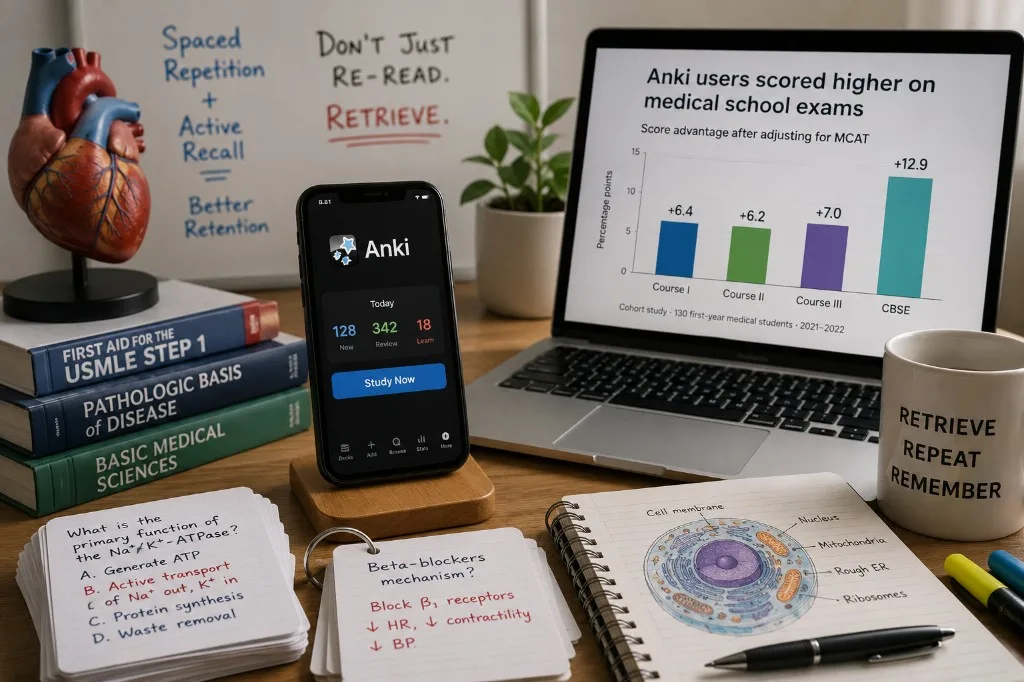
Illustration: exam prep with Anki and active recall — conceptual image, not from the cited study.
Short version
Anki has become almost a standard tool among medical students. The app is built around two well-studied learning principles: spaced repetition and active recall.
A new cohort study at a U.S. medical school found that students who used Anki to prepare for exams scored higher on average than classmates who did not — even after researchers tried to account for baseline academic level, such as pre-admission MCAT scores.
Across exams, the advantage was roughly 6 to 13 percentage points.
An important nuance: students were not simply left alone with the app. They also received training on how spaced repetition works, why retrieval practice matters, and how to organize decks.
What the researchers studied
The study took place at Boonshoft School of Medicine during the 2021–2022 academic year.
It followed 130 first-year medical students.
All students were invited to optional Anki training sessions covering:
- how spaced repetition works;
- why active recall supports memory;
- how to build decks aligned with current lectures and exams.
Researchers later split participants into:
- those who used Anki for at least one exam;
- and those who did not use it at all.
In total, 78 students reported using Anki, while 52 prepared with other methods.
The team compared scores on several NBME course exams and the year-end Comprehensive Basic Science Exam (CBSE).
Because Anki users had slightly higher MCAT percentiles on average, the authors used statistical models to separate app effects from incoming preparation.
Students were also asked how heavily they relied on Anki while studying: lightly, moderately, or strongly.
What they found
After adjusting for MCAT performance, Anki users still scored higher on nearly every exam analyzed.
Approximate differences:
- Course I — about +6.4%
- Course II — about +6.2%
- Course III — about +7.0%
- Year-end CBSE — about +12.9%
Students who relied more heavily on Anki in daily preparation tended to outperform occasional users.
Another notable finding: specific in-app metrics — such as cards per day — did not show a stable link to exam scores.
What mattered more was regular, intentional use of the system — not chasing dashboard records.
Why this matters
Medical education involves enormous factual load under time pressure.
Methods that fight forgetting become especially valuable. This study supports the idea that Anki is not only popular among high performers — when used with guidance, it may help sustain knowledge for high-stakes exams.
But the paper also highlights:
effectiveness depends not only on the app, but on whether learners know how to use it.
Installing Anki is not enough. You still need:
- regular reviews;
- manageable daily load;
- well-maintained decks;
- and understanding why spacing and retrieval matter.
Practical implications
For students, the takeaway is pragmatic:
Short daily reviews usually beat rare all-night cram sessions.
Helpful habits include:
- keeping a small daily card quota;
- syncing decks with current coursework;
- avoiding huge review backlogs;
- starting early instead of one week before an exam.
The study included explicit Anki onboarding — a step many programs skip. People often abandon spaced repetition not because the method fails, but because they start with overloaded decks and unrealistic schedules.
Limitations
This was an observational study at one institution, not a randomized trial.
Students chose whether to use Anki, so motivation and discipline may still explain part of the gap.
The work focuses on exam scores more than long-term clinical performance or retention years later.
Authors also note that internal Anki statistics weakly predicted success on their own — so “more cards per day” is not automatically better.
Final thoughts
Anki combines two well-studied approaches:
- spaced repetition over time;
- and active recall instead of passive rereading.
This cohort study adds practical evidence that the combination may help in demanding programs like medicine — especially when students learn how to use the tool, not only that it exists.
The simplest lesson may be:
spaced repetition works best as a steady habit, not as emergency mode right before an exam.