
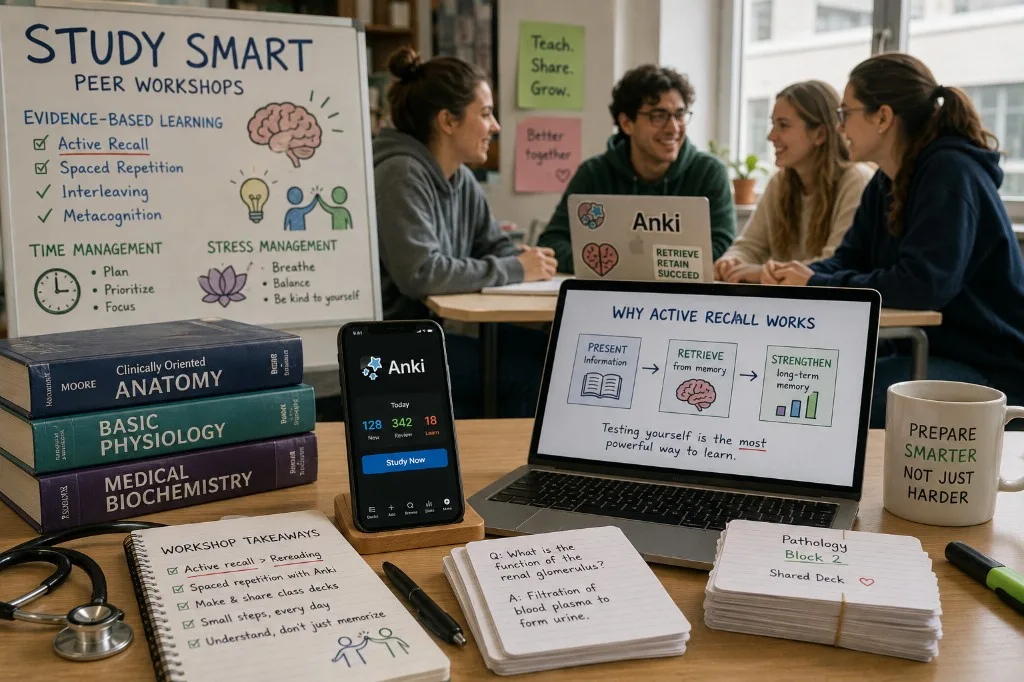
Illustration: peer workshops on evidence-based study strategies — conceptual image, not from the cited study.
Short version
Medical school teaches enormous amounts of information — but many students still receive very little formal guidance on how to study effectively.
At Mannheim Medical Faculty in Germany, students created a peer-led workshop series called Study Smart to address that gap. The program focused on evidence-based learning strategies, time management, stress regulation, and practical study habits.
A follow-up survey found that students who attended the workshops were more likely to use active recall methods, including the Anki flashcard app, than students who had not participated.
Over time, the project spread beyond one university and became part of a wider student-led initiative across Germany.
What the researchers studied
The project started in 2018 after medical students at Mannheim surveyed classmates about their biggest learning challenges.
The strongest demand was not for more lectures or additional content. Students wanted practical guidance on:
- how to learn efficiently;
- how to manage study time;
- and how to avoid burnout during medical training.
In response, student organizers built a two-day workshop series taught by trained peer instructors rather than professors.
The sessions covered topics such as:
- evidence-based learning strategies;
- active recall and spaced repetition;
- self-regulated learning;
- goal setting;
- and stress management.
The workshops became popular enough to evolve into a recurring part of student support at Mannheim. Later, the program expanded through the German Medical Students’ Association, with peer-training weekends helping other universities adopt the same model.
In 2021, researchers surveyed:
- 68 former workshop participants;
- and 72 students who had not attended.
The survey took place roughly two months after the workshop series.
What they found
Students who attended Study Smart reported using active recall strategies more often than non-participants.
One of the clearest differences involved Anki.
About 33% of workshop participants reported using Anki, compared with roughly 10% in the comparison group.
Participants also described building and sharing collaborative Anki decks with classmates — turning spaced repetition into a more social and coordinated learning system rather than a completely solitary habit.
Over five years, more than 1,000 medical students across Germany participated in Study Smart workshops across multiple medical faculties and online events.
Interestingly, there was no major difference between groups when students rated overall satisfaction with their own learning strategies.
That may suggest workshops can change specific habits before they change broader academic confidence.
Why this matters
Many students already hear phrases like:
“use active recall”
or
“try spaced repetition.”
But knowing the vocabulary of learning science is not the same as actually building sustainable study habits under exam pressure.
The Study Smart project suggests that peer-led teaching may lower the barrier to trying evidence-based methods.
Students may be more willing to experiment with tools like Anki when guidance comes from classmates who recently faced the same exams and workload.
The study also highlights an important pattern in modern learning systems:
spaced repetition does not always have to be solitary.
Shared class decks can synchronize daily review with current lectures and reduce the setup burden that often discourages beginners.
For universities and student organizations, the project offers a practical model:
- identify real student needs;
- teach study skills explicitly;
- use peer instructors;
- and build lightweight systems that can spread organically through student communities.
What this could mean in practice
For students, the study reinforces a simple idea:
Learning strategies become easier to sustain when they are embedded in a community rather than treated as isolated productivity hacks.
That can include:
- shared Anki decks;
- small peer study groups;
- collaborative review systems;
- or structured onboarding for spaced repetition.
The workshops also remind us that study skills themselves may deserve formal teaching.
Many students spend years optimizing note-taking styles or rereading habits without ever receiving practical instruction on retrieval practice, spacing, or cognitive load.
Important limitations
The evaluation was based on a survey at one medical faculty rather than a randomized controlled trial.
Students chose whether to attend the workshops, so participants may already have been more motivated or open to new study methods.
The study measured self-reported behavior rather than direct exam improvements linked specifically to the workshops.
The authors also note practical challenges in scaling peer-led systems nationally. Volunteer student instructors graduate quickly, making long-term continuity difficult without ongoing mentor networks and training systems.
Final thoughts
Study Smart shows that students can successfully teach other students how to learn — not only what to memorize.
The project also reflects a broader shift in education:
Evidence-based learning strategies become much easier to adopt when they are supported by community, structure, and realistic guidance rather than abstract advice alone.
For many programs, the missing ingredient may not be more content, but better systems for helping students study intelligently before workload alone becomes the strategy.